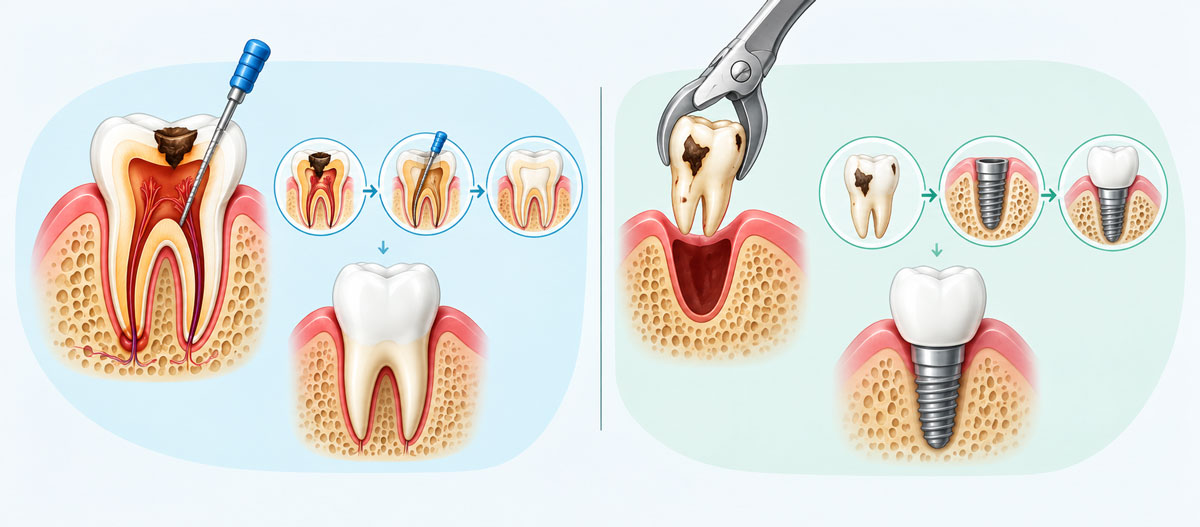
When you have a damaged, decayed, infected, or painful tooth, one of the most important questions is whether the tooth should be saved with root canal treatment or removed with a tooth extraction. In many cases, saving the natural tooth with root canal treatment is preferred when the tooth can be predictably restored and has a reasonable long-term prognosis. However, extraction may be the better option when extensive decay, a severe fracture, inadequate bone or gum support, or other factors make saving the tooth unrealistic.
At Novacare Dental in Kothrud, Pune, the decision is based on the condition of the individual tooth rather than pain alone. A dental examination, X-rays, and appropriate clinical tests can help determine whether a tooth can be treated and restored or whether extraction should be considered.
What Is Root Canal Treatment?
Root canal treatment, also called endodontic treatment, is a procedure used to treat a tooth when the pulp—the soft tissue inside the tooth—has become inflamed or infected. The aim of root canal treatment is to remove the diseased tissue, eliminate infection from the root canal system, and preserve the natural tooth.
During root canal treatment, your dentist generally:
- Examines the tooth and takes appropriate dental X-rays.
- Administers local anaesthesia to keep you comfortable.
- Removes the inflamed or infected pulp.
- Cleans and disinfects the root canal system.
- Fills and seals the cleaned canals.
- Restores the tooth with an appropriate filling, crown, or other restoration depending on the tooth and the amount of remaining structure.
A suitable final restoration is an important part of protecting the treated tooth and restoring its function.
When Might a Root Canal Be Needed?
A dentist may consider root canal treatment when a tooth has:
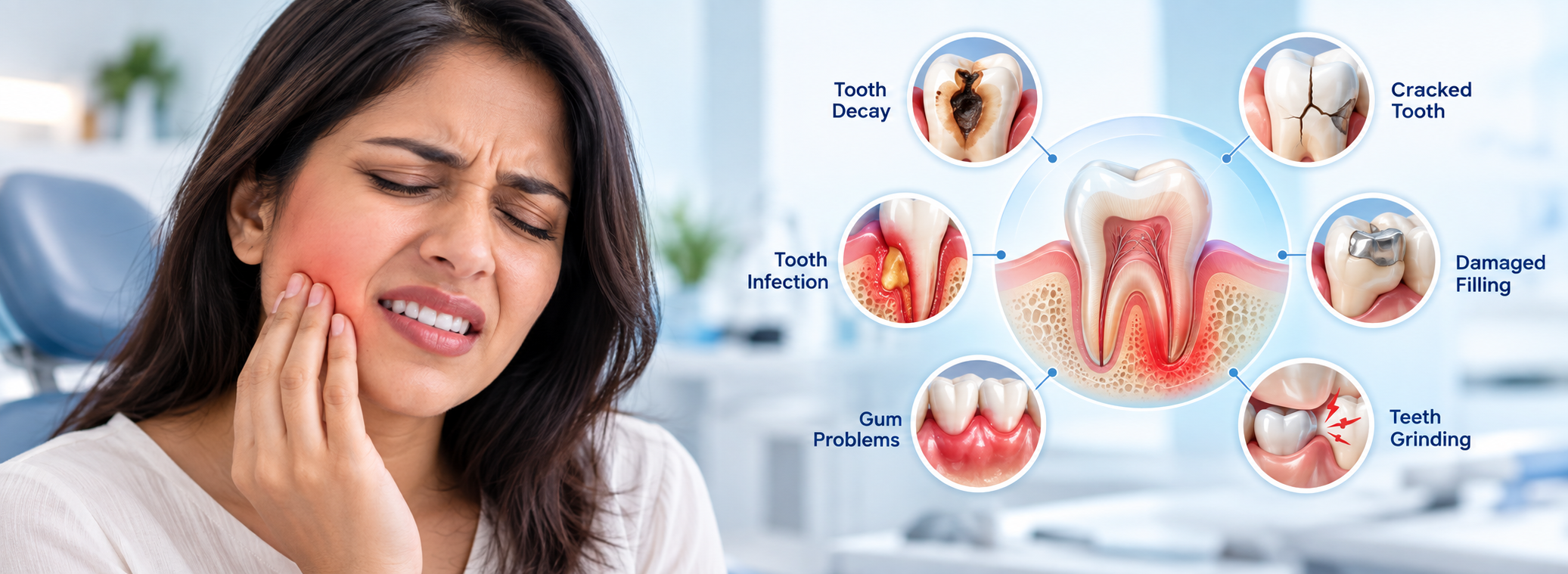
- Deep dental decay that has reached or affected the pulp
- Inflammation or infection of the pulp
- An abscess associated with the tooth
- Certain cracks, chips, or traumatic injuries
- Persistent symptoms consistent with pulp disease
- Previous dental treatment that has affected the pulp
Symptoms can include severe or persistent toothache, prolonged sensitivity to hot or cold, pain while biting, swelling, or tenderness around the tooth. However, symptoms alone cannot determine whether a root canal is necessary. A proper dental examination is needed to identify the cause of the problem and assess whether the tooth is restorable.
What Are the Advantages of Root Canal Treatment?
When a tooth has a reasonable prognosis and can be properly restored, preserving the natural tooth may offer several advantages.
Preserves the Natural Tooth
Root canal treatment allows the affected tooth to remain in the mouth instead of removing it.
Maintains Function
Once properly treated and restored, the tooth can continue to contribute to normal biting and chewing.
Avoids an Immediate Missing-Tooth Space
Extraction creates a space where the tooth was located. Depending on the tooth, its position, and your overall dental condition, replacement may subsequently be recommended.
May Avoid Additional Tooth-Replacement Treatment
After an extraction, replacement options can include a dental implant, bridge, or removable partial denture. These treatments have their own indications, costs, treatment times, maintenance requirements, and considerations.
What Is a Tooth Extraction?
A tooth extraction is the complete removal of a tooth from its socket. Extraction may be necessary when a tooth is too damaged or compromised to be predictably restored. However, an infected or painful tooth does not automatically need to be extracted. Your dentist will assess the tooth and surrounding tissues to determine whether retaining the tooth is realistic and whether treatment can provide a satisfactory long-term outcome.
During an extraction, the dentist typically:
- Examines the tooth and surrounding area.
- Uses dental X-rays or other appropriate investigations when required.
- Administers local anaesthesia.
- Carefully removes the tooth.
- Provides instructions for caring for the extraction site during healing.
In some cases, additional procedures may be required depending on the complexity of the extraction.
When Might Tooth Extraction Be Necessary?
Extraction may be considered when:
- The tooth is severely damaged and cannot be predictably restored
- Extensive decay has destroyed too much healthy tooth structure
- A fracture makes restoration impractical or has a poor prognosis
- The tooth has inadequate periodontal or bone support
- Infection or other disease cannot be predictably managed while retaining the tooth
- Previous treatment has failed and further tooth-saving treatment is not appropriate
- The overall prognosis of the tooth is unfavourable
The location and function of the tooth, the remaining tooth structure, supporting tissues, previous treatment, and your overall oral health all contribute to the decision.
Root Canal vs Tooth Extraction: Key Differences
Understanding the difference between root canal treatment and extraction can help you discuss your options with your dentist.
| Factor | Root Canal Treatment | Tooth Extraction |
|---|---|---|
| Main objective | Save the natural tooth | Remove the affected tooth |
| Is the natural tooth retained? | Yes | No |
| What happens to infected pulp? | It is removed and the canals are cleaned and sealed | The entire tooth is removed |
| Restoration | A filling, crown, or other restoration may be needed | Tooth replacement may be recommended |
| Natural chewing function | Can be maintained after appropriate treatment and restoration | The missing tooth may affect function until replaced |
| Further treatment | Final restoration and dental follow-up | May involve an implant, bridge, denture, or another replacement option |
| Generally suited for | A tooth that can be predictably treated and restored | A tooth that cannot be predictably saved |
Root Canal vs Extraction: Which Is Better?
There is no single treatment that is better for every patient or every tooth.
If a tooth can be predictably treated and restored, preserving the natural tooth with root canal treatment is often preferred.
A natural tooth can provide normal function and does not require replacement simply because the pulp has become infected. Root canal treatment addresses the infection inside the tooth while allowing the tooth itself to remain.
However, root canal treatment should not be performed simply to avoid extraction when the tooth has a poor prognosis. If severe structural damage, an unfavourable fracture, inadequate periodontal support, or another problem makes restoration unreliable, extraction may be the more appropriate option.
The goal is therefore not to choose a root canal at all costs. The goal is to choose the treatment that offers the most predictable long-term outcome for the patient.
Why Is Saving a Natural Tooth Often Preferred?
Whenever a tooth can be predictably restored and maintained, keeping the natural tooth has potential benefits.
1. It Preserves Your Natural Tooth
A successful root canal treatment followed by appropriate restoration allows the tooth to remain in the mouth.
2. It Can Maintain Chewing Function
A properly treated and restored tooth can continue to contribute to biting and chewing.
3. It Avoids an Immediate Missing-Tooth Space
After extraction, the resulting space may or may not need to be replaced depending on the location of the tooth, its function, your bite, and your overall treatment plan.
4. It May Avoid Tooth-Replacement Treatment
Replacing an extracted tooth may involve an implant, bridge, removable denture, or another restorative approach. These options can require additional procedures and planning.
When Is Tooth Extraction Better Than Root Canal Treatment?
Although preserving a natural tooth is often desirable, there are situations where extraction provides a more predictable solution.
Severely Damaged Tooth
Root canal treatment treats disease inside the tooth, but it cannot replace tooth structure that has already been lost. If too little healthy tooth structure remains to support a durable restoration, the overall prognosis may be poor.
Certain Severe Tooth Fractures
Some fractures can make a tooth unsuitable for predictable restoration. The location, depth, and extent of the fracture are important in determining the prognosis.
Poor Periodontal Support
A tooth may have a poor long-term prognosis because of significant loss of the bone or tissues supporting it, even if the root canal system itself can technically be treated.
Unfavourable Overall Prognosis
Your dentist considers the complete clinical picture, including the remaining tooth structure, roots, periodontal support, infection, previous dental treatment, position of the tooth, function, and whether a durable restoration can be provided.
Is a Root Canal More Painful Than an Extraction?
Fear of pain is one of the most common reasons people hesitate to seek dental treatment. Modern root canal treatment is generally performed under local anaesthesia. The purpose of treatment is to remove the inflamed or infected pulp that may be responsible for dental pain. Tooth extraction is also performed using appropriate anaesthesia. Some soreness or discomfort can occur after either procedure, and recovery can vary depending on the tooth, the complexity of treatment, and the individual patient.
Pain should therefore not be the only factor when deciding between root canal treatment and extraction. If you have severe dental pain, swelling, or sensitivity, getting the tooth examined promptly is more useful than trying to determine the treatment based on symptoms alone.
What Happens After Root Canal Treatment?
After the root canal system has been cleaned, treated, and sealed, the tooth needs an appropriate final restoration. Depending on the tooth’s location, how much tooth structure remains, and the forces placed on it, the final restoration may involve a filling, crown, or another restorative approach. The final restoration is important because a root canal-treated tooth can remain vulnerable to fracture if it is not adequately protected. Good oral hygiene, regular dental examinations, and appropriate care of the restoration are also important for maintaining the treated tooth.
What Happens After Tooth Extraction?
After extraction, the socket gradually heals. Your dentist will provide instructions about caring for the extraction site, including guidance about eating, oral hygiene, and activities during the initial healing period.
Depending on the tooth that has been removed and your individual dental needs, replacement may be considered using:
- A dental implant
- A fixed dental bridge
- A removable partial denture
- Another appropriate restorative option
Not every extracted tooth requires the same replacement plan. Your dentist can assess whether replacement is necessary and which option is appropriate for your situation.
Root Canal or Extraction: How Does a Dentist Decide?
The key question is whether the tooth can be predictably saved, restored, and maintained.
During your assessment, your dentist may evaluate:
- The extent of tooth decay
- The amount of healthy tooth structure remaining
- The condition of the pulp and root canal system
- The presence and extent of infection
- Cracks or fractures
- Gum and bone support
- Previous dental treatment
- The position and function of the tooth
- Whether the tooth can be adequately restored after treatment
- Your overall oral health and treatment goals
Dental X-rays and clinical tests can provide important information when assessing these factors. In some cases, the decision may also require consultation with an endodontist, periodontist, prosthodontist, or another dental specialist.
Can an Infected Tooth Heal Without Treatment?
An infection within the root canal system generally requires definitive dental treatment. Antibiotics may be appropriate in specific situations, such as when there are signs of spreading infection or systemic involvement. However, antibiotics alone generally do not eliminate the source of infection inside a diseased root canal system. Depending on the condition of the tooth, definitive treatment may involve root canal treatment or extraction. Delaying treatment can allow dental disease or infection to progress, potentially making treatment more complicated and reducing the options available for saving the tooth.
When Should You See a Dentist?
Arrange a dental evaluation if you experience:
- Persistent or severe tooth pain
- Swelling around a tooth or gum
- Pain while chewing or biting
- A broken or significantly cracked tooth
- Prolonged sensitivity to hot or cold
- A gum swelling or discharge near a tooth
- Facial swelling associated with dental pain
Seek urgent dental or medical attention if you develop significant facial swelling, difficulty swallowing or breathing, or other signs of a serious spreading infection.
Early assessment can sometimes provide more treatment options and may improve the possibility of preserving a damaged tooth.
Frequently Asked Questions
Is it better to have a root canal or extraction?
When a tooth can be predictably treated and restored, preserving it with root canal treatment is often preferred. Extraction may be more appropriate when the tooth is too damaged or has a poor long-term prognosis.
Can a badly damaged tooth still be saved with a root canal?
Sometimes. Root canal treatment can treat disease inside the tooth, but enough healthy tooth structure and supporting tissue must remain for the tooth to be restored and maintained successfully. A dental examination is necessary to determine whether the tooth is restorable.
What happens if I choose extraction instead of a root canal?
The tooth is permanently removed. Depending on the tooth and your individual circumstances, your dentist may discuss whether it should be replaced with a dental implant, bridge, removable denture, or another option.
Does a root canal remove the tooth nerve?
Root canal treatment removes inflamed or infected pulp tissue from inside a mature tooth, including the nerve tissue within the pulp. The cleaned canal system is then filled and sealed.
Do you always need a crown after a root canal?
Not always. The appropriate final restoration depends on the tooth’s location, remaining tooth structure, functional load, and other clinical factors. Many back teeth require protection against fracture and may benefit from a crown or another form of cuspal protection.
Can an extracted tooth be replaced immediately?
In selected cases, immediate replacement or immediate implant placement may be possible. However, not every patient or extraction site is suitable. Factors such as bone condition, infection, anatomy, and overall health need to be evaluated first.
How long can a root canal-treated tooth last?
A properly treated and appropriately restored tooth can function for many years. Its longevity depends on factors such as the condition of the tooth before treatment, quality of the root canal treatment and restoration, oral hygiene, bite forces, and ongoing dental care.
Can antibiotics cure an infected tooth instead of a root canal?
Antibiotics alone generally cannot eliminate infection originating inside a necrotic or infected root canal system. Definitive dental treatment is usually required, with antibiotics reserved for situations where they are clinically indicated.
Is extraction always cheaper than a root canal?
The initial cost of extraction may be lower than root canal treatment and restoration. However, removing a tooth can create a need for additional treatment if the tooth needs to be replaced. The overall cost and treatment plan therefore depend on the individual tooth and the replacement options being considered.
Conclusion
When considering root canal vs tooth extraction, the goal should be to choose the treatment that provides the most predictable long-term outcome. If a tooth can be successfully treated and restored, root canal treatment can remove diseased pulp and infection while preserving the natural tooth. If severe structural damage, an unfavourable fracture, inadequate supporting tissues, or another condition makes the tooth unsuitable for predictable restoration, extraction may be the more appropriate choice.
The decision should be made after a proper dental examination, appropriate X-rays and clinical tests, and a discussion with your dentist about the tooth’s prognosis and available treatment options. If you have a painful, infected, cracked, or badly damaged tooth, Novacare Dental in Kothrud, Pune can assess your tooth and help determine whether it may be suitable for root canal treatment or whether extraction and subsequent tooth replacement should be considered.
Book a dental consultation with Novacare Dental for an individual assessment and treatment plan.