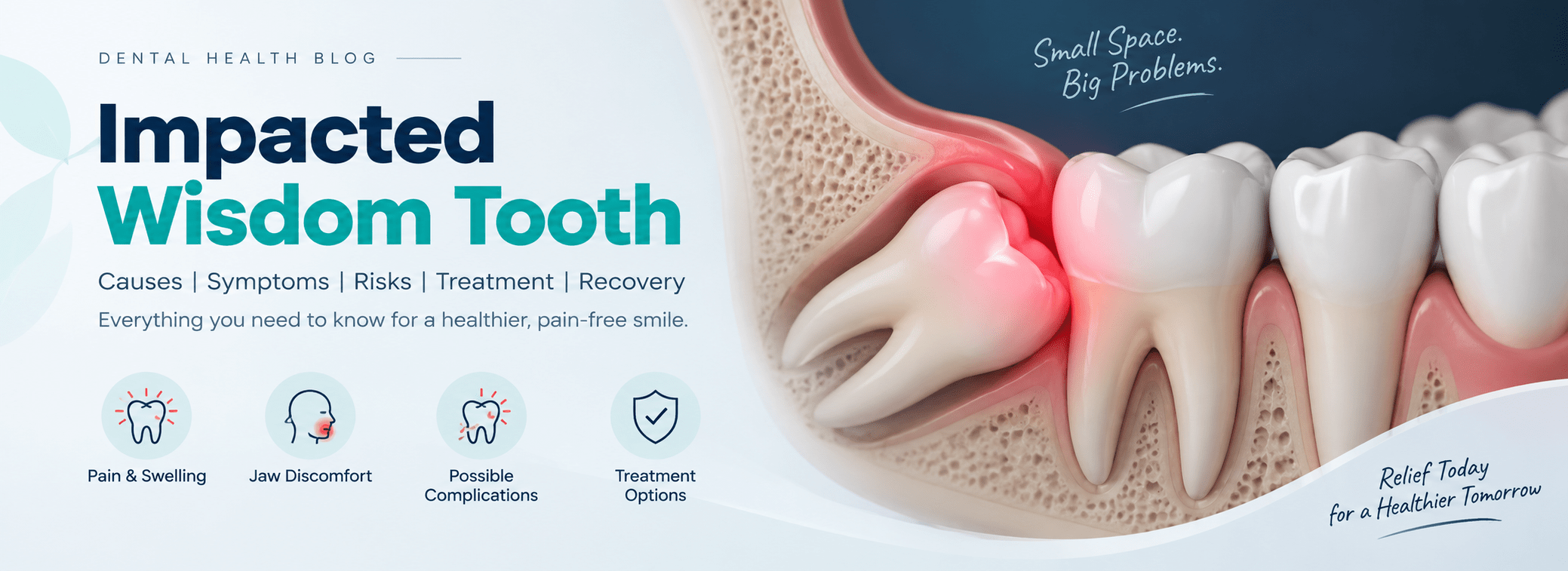
An impacted wisdom tooth is a third molar that does not fully erupt into its normal position, often because there is insufficient space, its eruption path is blocked, or the tooth is angled abnormally. Impacted wisdom tooth symptoms can include pain at the back of the jaw, swollen or tender gums, difficulty opening the mouth, food trapping, bad taste, or recurrent gum infection. However, some impacted wisdom teeth cause no noticeable symptoms and are discovered during a dental examination or X-ray. Treatment depends on the tooth’s position, symptoms, effect on nearby teeth and gums, and overall oral health. Not every impacted wisdom tooth automatically requires removal, but problematic teeth may need wisdom tooth extraction.
What Is an Impacted Wisdom Tooth?
An impacted wisdom tooth is a wisdom tooth that is unable to erupt fully into a functional position in the mouth. Wisdom teeth, also called third molars, are the last permanent teeth at the back of the mouth. When there is insufficient room or the tooth develops at an unfavourable angle, it may remain partly or completely trapped beneath the gum or bone. Impaction may affect one or more wisdom teeth and can occur in the upper or lower jaw.
What Causes an Impacted Wisdom Tooth?
A common reason for wisdom tooth impaction is inadequate space at the back of the jaw for the third molar to erupt normally.
Other factors can include:
- The angle at which the wisdom tooth develops
- Obstruction by the neighbouring second molar
- Tooth position within the jaw
- Available jaw space
- Individual tooth and jaw anatomy
A dental examination and X-ray can help determine the exact position and eruption pattern.
What Are the Symptoms of an Impacted Wisdom Tooth?
Not every impacted tooth causes symptoms. Problems are more likely when a partially impacted wisdom tooth creates an area where plaque, bacteria and food debris can accumulate or when the tooth affects surrounding structures.
Common Impacted Wisdom Tooth Symptoms
Possible symptoms include:
- Pain or tenderness behind the last molar
- Swollen or red gums
- Pain while chewing
- Difficulty opening the mouth comfortably
- Swelling around the jaw
- Food trapping around a partially erupted tooth
- Unpleasant taste
- Bad breath associated with local inflammation or infection
- Recurrent gum swelling around the wisdom tooth
Pain in the back of the jaw is not always caused by a wisdom tooth, so a dental assessment is important before deciding on treatment.
What Are the Different Types of Impacted Wisdom Teeth?
The types of impacted wisdom teeth are often described according to the angle or direction of the third molar.
1. Mesial or Mesioangular Impaction
In a mesioangular impacted wisdom tooth, the tooth tilts forward toward the second molar. This is a commonly encountered orientation, particularly for lower wisdom teeth. Depending on its position and available space, the tooth may be partially or completely impacted.
2. Vertical Impaction
A vertically impacted wisdom tooth is relatively upright but does not fully erupt into the mouth. Whether it requires treatment depends on factors such as symptoms, eruption potential, hygiene access and effects on surrounding tissues.
3. Horizontal Impaction
A horizontal wisdom tooth lies at a more sideways angle within the jaw. It may be positioned toward the adjacent second molar. The relationship between the impacted tooth, nearby tooth roots, bone and other anatomical structures must be assessed before treatment.
4. Distal or Distoangular Impaction
A distoangular impacted wisdom tooth tilts backward, away from the second molar. The treatment decision depends on its exact position, symptoms and potential effect on surrounding tissues.
5. Partial vs Complete Wisdom Tooth Impaction
Impacted wisdom teeth can also be classified according to how much of the tooth has erupted.
6. Partially Impacted Wisdom Tooth
Part of the crown has emerged through the gum, but the tooth has not fully erupted. A gum flap can remain over part of the tooth, making the area difficult to clean and potentially allowing food and bacteria to accumulate.
7. Completely Impacted Wisdom Tooth
The wisdom tooth remains entirely below the gum and may also be partly or completely surrounded by bone. A fully impacted tooth may cause no symptoms, but its position and surrounding structures can still be evaluated through dental imaging.
Can an Impacted Wisdom Tooth Cause Infection?
Yes. A partially impacted wisdom tooth can sometimes develop inflammation or infection of the gum tissue around it, known as pericoronitis.
Signs of Wisdom Tooth Infection or Inflammation
Possible signs include:
- Pain around the wisdom tooth
- Red or swollen gum tissue
- Difficulty chewing
- Unpleasant taste
- Difficulty opening the mouth
- Local swelling
- Pus or discharge in some cases
More significant infection can occasionally produce facial swelling, fever or other systemic symptoms. Prompt dental assessment is important if infection is suspected.
What Problems Can an Impacted Wisdom Tooth Cause?
Some impacted wisdom teeth remain stable without causing problems. Others can contribute to dental disease.
Potential complications include:
Gum Inflammation
Partially erupted teeth can be difficult to clean and may develop recurrent inflammation around the gum.
Tooth Decay
Food and plaque can collect around a partially erupted wisdom tooth, increasing the risk of decay in the wisdom tooth or sometimes the adjacent second molar.
Gum Disease
Difficult-to-clean areas around impacted teeth may contribute to periodontal problems.
Damage to the Adjacent Tooth
Depending on the position of the wisdom tooth, the neighbouring second molar can sometimes be affected.
Cysts
In some cases, cystic changes can develop around an impacted tooth and may affect surrounding bone or structures. These possibilities are why dentists assess more than pain alone when evaluating an impacted third molar.
How Is an Impacted Wisdom Tooth Diagnosed?
Diagnosis usually starts with a dental examination.
The dentist or oral surgeon may assess:
- Gum condition
- Whether the tooth has partially erupted
- Swelling or signs of infection
- Condition of the adjacent second molar
- Mouth opening
- Areas of tenderness
Why Are Dental X-Rays Used for Impacted Wisdom Teeth?
Dental imaging helps show the position and angle of the wisdom tooth, surrounding bone, adjacent teeth and relevant anatomical structures. For some lower wisdom teeth, the relationship between the tooth roots and the nerve canal in the jaw is particularly important when planning surgery. Additional imaging may be considered in selected cases when clinically necessary.
What Are the Treatment Options for an Impacted Wisdom Tooth?
Impacted wisdom tooth treatment depends on whether the tooth is causing disease or has a significant risk of future problems.
1. Monitoring
An impacted wisdom tooth that is symptom-free and shows no evidence of disease may sometimes be monitored rather than immediately removed.
Regular dental examinations allow changes to be identified over time.
2. Managing Acute Inflammation or Infection
When inflammation develops around a partially erupted tooth, initial management can involve professional cleaning or irrigation of the area and advice on local oral hygiene.
Other treatment may be required depending on the severity and spread of infection. Antibiotics are not automatically required for every episode and should be prescribed only when clinically indicated.
3. Wisdom Tooth Extraction
Wisdom tooth extraction may be recommended when an impacted tooth is associated with problems such as recurrent infection, decay, damage to neighbouring teeth, certain cystic changes, or other clinically significant disease. The decision is based on the expected benefits and risks for the individual patient.
How Is Impacted Wisdom Tooth Extraction Performed?
The procedure varies according to the tooth’s position. After appropriate anaesthesia, the oral surgeon or dentist accesses the impacted tooth. In some cases, gum tissue is opened and a small amount of surrounding bone may need to be removed. The tooth may be divided into sections to allow controlled removal. The area is then cleaned and stitches may be placed when required. The complexity of impacted wisdom tooth removal depends on factors such as tooth angle, root shape, depth of impaction and proximity to important anatomical structures.
What Is Recovery Like After Wisdom Tooth Removal?
Some pain, swelling and jaw stiffness are common after surgical wisdom tooth removal. These usually improve during the initial recovery period, although recovery varies between patients and procedures.
Follow the post-operative instructions provided by your dentist or oral surgeon regarding:
- Pain medication
- Oral hygiene
- Food and fluids
- Activity
- Caring for the extraction site
- Follow-up appointments
Contact your dental professional if symptoms become significantly worse rather than gradually improving.
When Should You See a Dentist for Wisdom Tooth Pain?
Arrange a dental examination if you have persistent wisdom tooth pain, recurrent swelling, difficulty chewing, food trapping, unpleasant taste, gum inflammation or difficulty opening your mouth. Seek prompt medical or dental attention if swelling becomes severe, spreads to the face or neck, or is accompanied by difficulty swallowing or breathing. Early evaluation can help determine whether the problem can be managed conservatively or whether wisdom tooth extraction should be considered.
Frequently Asked Questions About Impacted Wisdom Teeth
Does every impacted wisdom tooth need to be removed?
No. An impacted wisdom tooth without symptoms or evidence of disease may sometimes be monitored. Removal is generally considered when there is existing disease or a clinically significant reason for treatment.
How do I know if my wisdom tooth is impacted?
You may experience pain, swelling or recurrent gum inflammation, but some impacted teeth have no symptoms. A dental examination and X-ray can confirm the tooth’s position.
What is a partially impacted wisdom tooth?
It is a wisdom tooth where part of the crown has erupted through the gum while the remainder remains covered by gum tissue or bone.
Can an impacted wisdom tooth damage the tooth next to it?
Yes, in some cases. Its position and difficulty with cleaning can contribute to decay, periodontal problems or other damage involving the adjacent second molar.
Is impacted wisdom tooth removal painful?
The procedure is performed using appropriate anaesthesia. Patients may experience soreness, swelling and jaw stiffness during recovery, which can usually be managed according to the surgeon’s post-operative instructions.
Can antibiotics cure an impacted wisdom tooth?
Antibiotics do not change the physical position of an impacted tooth. They may be appropriate for certain infections when clinically indicated, but recurrent problems may require definitive dental treatment.
What happens if an impacted wisdom tooth is not removed?
Some remain problem-free and can be monitored. Others may develop inflammation, decay, periodontal disease or other complications. The decision should be based on individual clinical and radiographic findings.
Who should evaluate a complicated impacted wisdom tooth?
A dentist can perform the initial assessment. More complex cases may be evaluated and treated by an oral and maxillofacial surgeon, particularly when surgical anatomy or other clinical factors increase complexity.
Conclusion
An impacted wisdom tooth occurs when a third molar cannot fully erupt into its normal position. It may be mesioangular, vertical, horizontal or distoangular, and can be either partially or completely impacted. While some impacted wisdom teeth remain symptom-free, others can cause wisdom tooth pain, gum inflammation, infection, tooth decay, periodontal problems or damage to neighbouring teeth. Treatment should therefore be based on the tooth’s position, symptoms, surrounding structures and evidence of disease—not simply on the presence of an impacted tooth.
If you are experiencing pain, swelling or recurrent problems around a wisdom tooth, Novacare Dental in Kothrud, Pune can assess the tooth clinically and with appropriate dental imaging to determine whether monitoring, treatment of local inflammation or impacted wisdom tooth extraction is appropriate.
Book a consultation with Novacare Dental for an individual wisdom tooth assessment and treatment plan.