What Are Full Mouth Dental Implants?
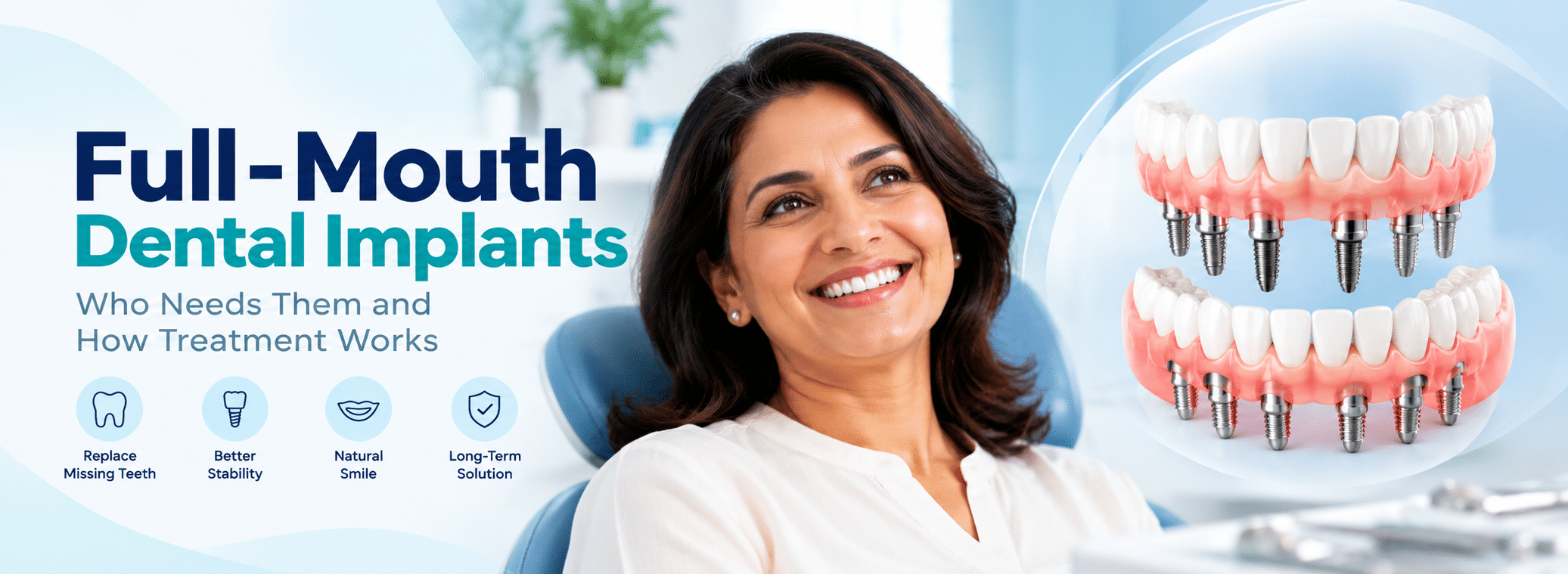
Full mouth dental implants are a treatment option used to replace most or all missing or severely compromised teeth using strategically positioned dental implants that support a complete set of replacement teeth.
Instead of placing one implant for every missing tooth, several implants may be positioned within the jaw to support a fixed or removable full-arch prosthesis.
Full mouth implant treatment may involve the:
- Upper jaw
- Lower jaw
- Or both upper and lower jaws
Each treatment plan is different. The number and position of dental implants depend on the patient’s jawbone, gum health, bite, remaining teeth, prosthetic requirements, medical history and treatment goals.
For patients considering full mouth dental implants in Pune, a detailed clinical examination and digital treatment planning are essential before deciding whether implant treatment is appropriate.
Quick Answer: Who May Need Full Mouth Dental Implants?
Full mouth dental implants may be considered for people who:
- Have lost most or all of their natural teeth
- Have multiple teeth that cannot be predictably restored
- Experience difficulty using conventional removable dentures
- Require extensive full-mouth rehabilitation
- Want to explore a more stable implant-supported tooth replacement option
- Have adequate general and oral health for implant surgery
- Can maintain good long-term oral hygiene
However, missing teeth alone do not automatically make someone suitable for full mouth implants.
A dentist or implant clinician must first evaluate whether existing teeth can be preserved and whether the gums and jawbone can support implant treatment.
How Do Full Mouth Dental Implants Work?
Dental implants are small implant fixtures placed within the jawbone to act as artificial tooth-root supports.
Once properly positioned and healed, they can support a prosthesis containing multiple artificial teeth.
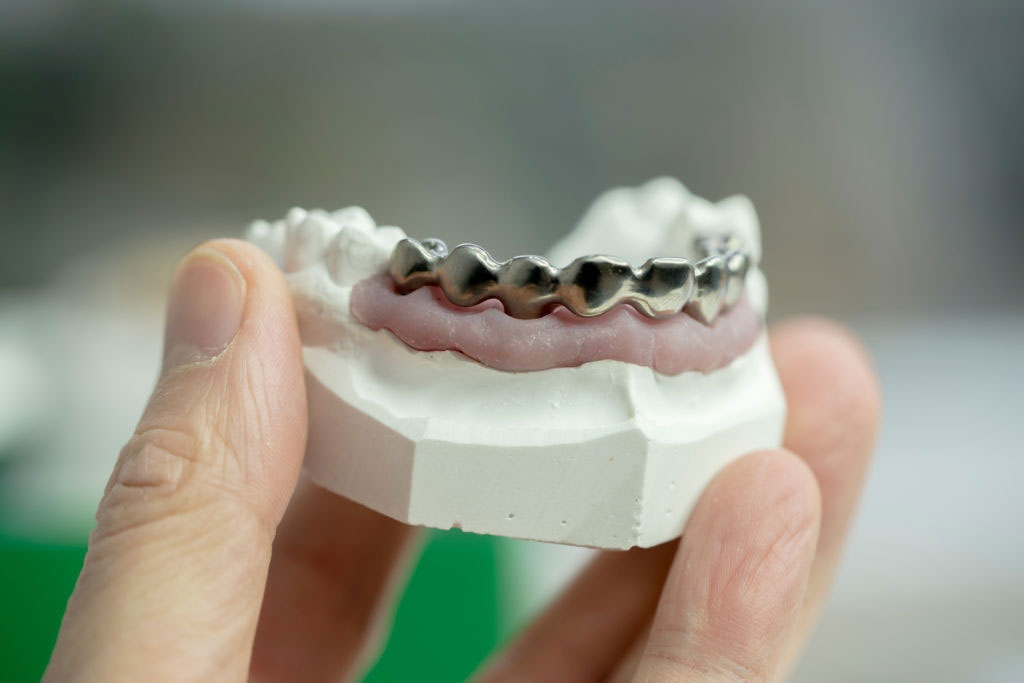
A full-arch restoration generally consists of:
- Dental implants placed within the jawbone
- Abutments or connecting components
- A fixed or removable prosthesis containing the replacement teeth
The objective is not simply to fill gaps. Full mouth implant treatment is planned to restore overall dental function, bite, appearance, speech, comfort and cleaning access.
Who May Need Full Mouth Dental Implant Treatment?
1. People Who Have Lost Most or All of Their Teeth
Patients who are completely or almost completely toothless may be evaluated for full arch dental implants.
Unlike traditional dentures that primarily rest on the gums, implant-supported restorations obtain additional support or retention from implants placed in the jawbone.
2. Patients With Multiple Severely Damaged Teeth
A person may still have several teeth but experience problems such as:
- Advanced tooth decay
- Severe periodontal disease
- Repeated dental treatment failures
- Significant fractures
- Extensive structural damage
- Poor long-term prognosis of multiple teeth
This does not mean all remaining teeth should automatically be extracted.
Whenever clinically reasonable, natural teeth should be carefully assessed for preservation before moving to full mouth implant treatment.
3. Denture Wearers Experiencing Poor Stability
Some patients adapt well to conventional dentures, while others may experience:
- Denture movement
- Difficulty chewing
- Reduced stability
- Discomfort
- Difficulty speaking confidently
- Problems adapting to removable dentures
For selected patients, implant-supported dentures or fixed implant teeth may provide greater stability.
4. Patients Requiring Full Mouth Rehabilitation
Extensive dental problems can affect more than appearance.
Severe tooth loss or damage may influence:
- Chewing ability
- Speech
- Bite
- Facial appearance
- Comfort
- Confidence
- Overall oral function
A comprehensive full mouth rehabilitation plan may combine dental implants with other restorative or periodontal procedures depending on the condition of the mouth.
Am I a Candidate for Full Mouth Dental Implants?
Not every patient with missing teeth is automatically suitable for dental implants.
Before recommending full mouth dental implant treatment, a dentist may assess several factors.
Jawbone Availability
Dental implants need suitable bone support.
The dentist evaluates both the amount and quality of available jawbone and determines whether the planned implant positions can be adequately supported.
Gum Health
Healthy gums and controlled periodontal conditions are important for long-term implant health.
Active gum disease may need to be treated before implant placement.
Remaining Natural Teeth
Any remaining teeth should be carefully evaluated.
The dentist may determine:
- Which teeth can be preserved
- Which teeth have a questionable prognosis
- Which teeth may need additional treatment
- Whether extraction is genuinely necessary
General Health
Medical history can influence surgical planning and healing.
Your dentist should therefore know about:
- Existing medical conditions
- Current medications
- Previous surgeries or treatments
- Smoking or tobacco habits
- Any other factors that could influence healing
Oral Hygiene
Dental implants require long-term cleaning and professional maintenance.
A patient must be willing and able to maintain the gums, implants and implant-supported prosthesis.
Bite and Jaw Relationship
Bite forces and the way the upper and lower jaws meet can affect implant position, prosthesis design and long-term function.
Patient Expectations
The treatment plan should also reflect what the patient expects regarding:
- Fixed or removable teeth
- Appearance
- Function
- Treatment duration
- Maintenance
- Surgical procedures
- Overall rehabilitation goals
What Happens Before Full Mouth Dental Implant Surgery?
A successful implant treatment plan begins well before surgery.
Comprehensive Dental Examination
The dentist examines:
- Existing teeth
- Gums
- Bite
- Jaw relationship
- Areas of infection
- Oral tissues
- Existing dental restorations
- Available space for replacement teeth
Dental X-Rays and CBCT Scan
Depending on the case, conventional dental X-rays and three-dimensional CBCT imaging may be recommended.
A CBCT scan can help the dentist assess:
- Jawbone dimensions
- Bone anatomy
- Important surrounding structures
- Proposed implant positions
- Areas where additional bone support may be required
Digital planning can help the surgical and prosthetic stages work together.
The final replacement teeth should ideally be considered while planning implant positions rather than treating implant placement and tooth design as completely separate stages.
Full Mouth Dental Implant Procedure: Step by Step
Full mouth implant treatment is generally completed through several stages.
The exact sequence varies from patient to patient.
Step 1: Consultation and Diagnosis
The first stage is a detailed consultation.
The dental team evaluates the teeth, gums, bone, medical history, bite and expectations.
A personalized treatment plan is then prepared.
Step 2: Treat Existing Oral Problems
Existing dental disease may need to be managed before implant placement.
Treatment may include:
- Periodontal treatment
- Treatment of active infections
- Restorative dental treatment
- Removal of teeth that cannot reasonably be retained
- Other procedures required to create a healthy foundation
Step 3: Tooth Extraction When Necessary
If certain remaining teeth cannot be preserved, extraction may form part of the treatment plan.
However, full mouth implant treatment should not automatically mean removing every natural tooth.
Preserving maintainable natural teeth remains an important consideration during treatment planning.
Step 4: Bone Grafting If Required
Some patients have insufficient bone in areas where implants are planned.
Depending on the situation, bone augmentation or grafting may be recommended.
However, not every full mouth implant patient needs a bone graft.
The requirement depends on:
- Existing bone volume
- Bone quality
- Implant position
- Jaw anatomy
- Surgical technique
- Prosthesis design
Step 5: Dental Implant Placement
During implant surgery, the planned implants are positioned in the jawbone.
There is no universal number of implants that applies to every full arch.
The required number depends on several factors, including:
- Bone availability
- Jaw anatomy
- Implant distribution
- Bite forces
- Prosthesis design
- Type of final restoration
- Whether one or both arches are being restored
Step 6: Temporary Teeth When Appropriate
In selected cases, temporary replacement teeth may be attached relatively soon after implant placement.
This approach is commonly described as immediate loading or immediate provisionalization.
However, same-day fixed temporary teeth are not suitable for every patient.
Factors including primary implant stability, bone condition, bite forces and surgical findings influence whether this option is appropriate.
Temporary teeth may also require dietary restrictions during healing.
Step 7: Healing and Osseointegration
After placement, dental implants require time to integrate with the surrounding bone.
This biological process is known as osseointegration.
Healing time varies depending on:
- Patient health
- Bone condition
- Implant position
- Additional surgical procedures
- Treatment protocol
- Individual healing response
Patients should carefully follow instructions regarding oral hygiene, medication, diet and follow-up appointments.
Step 8: Final Full-Arch Teeth
After adequate healing, the implants are evaluated and the definitive prosthesis can be planned.
When designing the final teeth, the dentist may consider:
- Bite
- Smile
- Facial proportions
- Tooth size
- Tooth shape
- Speech
- Comfort
- Functional requirements
- Hygiene access
- Gum and tissue appearance
The final objective is a stable and maintainable restoration designed around the patient’s individual oral condition.
Fixed vs Removable Full Mouth Dental Implants
There is more than one type of implant-supported full-mouth restoration.
Fixed Full-Arch Implant Teeth
A fixed full-arch prosthesis is secured to dental implants and is not normally removed by the patient for routine cleaning.
Patients still need to clean carefully around and underneath the restoration using techniques recommended by their dentist or hygienist.
Implant-Supported Removable Teeth
Another option is a removable prosthesis that receives additional support or retention from dental implants.
The patient can remove the prosthesis for cleaning as instructed.
Which Option Is Better?
There is no single design that is ideal for everyone.
The most appropriate choice depends on:
- Bone condition
- Gum and soft-tissue loss
- Implant positions
- Cleaning ability
- Bite
- Available space
- Functional expectations
- Patient preference
- Prosthetic requirements
Your dentist should explain the advantages and limitations of each approach before treatment.
What Are the Benefits of Full Mouth Dental Implants?
For appropriately selected patients, full mouth implants may provide several potential benefits.
Improved Stability
Implant-supported teeth may offer greater stability than conventional removable dentures for suitable patients.
Improved Chewing Function
A stable restoration may help improve chewing ability.
Patients should still follow dietary recommendations, particularly while the implants are healing.
Replacement of an Entire Dental Arch
Several strategically planned implants can support replacement teeth across an upper or lower arch.
Natural-Looking Smile Design
The final prosthesis can be designed around factors including:
- Face shape
- Smile line
- Tooth proportions
- Tooth position
- Bite
- Lip support
- Overall appearance
Improved Comfort and Confidence
Restoring missing or severely damaged teeth may improve comfort and confidence for many patients.
Results, however, vary depending on individual clinical circumstances.
Improved Denture Stability
For suitable denture wearers, implants can be used to provide increased retention or support compared with a conventional gum-supported denture.
Full Mouth Dental Implants vs Traditional Dentures
Both traditional dentures and implant-supported restorations can replace an entire arch of teeth, but they function differently.
| Feature | Full Mouth Dental Implants | Conventional Dentures |
|---|---|---|
| Support | Supported or retained by implants placed in the jaw | Primarily supported by gums and underlying tissues |
| Stability | Can provide greater stability in appropriate cases | Stability varies between patients |
| Surgery | Required | Usually not required |
| Bone requirement | Bone assessment is necessary | Implant-level bone requirements do not apply |
| Cleaning | Requires implant-specific daily cleaning | Removed and cleaned according to instructions |
| Maintenance | Long-term implant and prosthetic monitoring required | Denture and oral tissue monitoring required |
| Suitability | Depends on health, bone, gums and other factors | May be suitable where implants are not preferred or appropriate |
Neither option is universally better for every person.
The appropriate treatment depends on clinical findings, medical history, oral health, anatomy, expectations and personal preference.
Do Full Mouth Dental Implants Require Bone Grafting?
Not always.
Bone grafting is recommended only when additional bone support is required for the proposed implant treatment.
Patients who have experienced significant tooth loss may also have experienced changes in jawbone volume.
A CBCT scan and clinical examination can help determine whether bone augmentation may be necessary.
Some patients may undergo:
- Bone grafting
- Ridge augmentation
- Other site-development procedures
Other patients may have sufficient bone to proceed without grafting.
Can You Get Full Mouth Dental Implants With Bone Loss?
Possibly.
Having bone loss does not automatically rule out dental implant treatment.
The dentist must first determine:
- How much bone remains
- Where the bone loss has occurred
- Whether implants can be positioned appropriately
- Whether augmentation is required
- Whether another restorative approach would be more appropriate
This is why three-dimensional assessment and individualized treatment planning are important.
Can Full Mouth Implants Be Done in One Day?
Some carefully selected patients may receive implants and temporary fixed teeth on the same day.
However, the phrase “teeth in one day” can sometimes be misunderstood.
Receiving temporary teeth quickly does not mean that all biological healing and final restorative treatment are completed in a single day.
The implants still require healing, and the definitive prosthesis is generally completed after appropriate clinical evaluation and healing.
Immediate loading is also not suitable for every patient.
How Long Does Full Mouth Dental Implant Treatment Take?
There is no single treatment duration applicable to everyone.
The overall timeline can depend on:
- Whether teeth need extraction
- Gum health
- Existing infection
- Bone grafting requirements
- Number and position of implants
- Healing response
- Whether immediate temporary teeth are possible
- Final prosthetic procedures
Your dentist can provide a more realistic treatment timeline after diagnostic imaging and clinical assessment.
Are Full Mouth Dental Implants Painful?
Implant surgery is carried out using appropriate anaesthesia.
After treatment, patients may experience temporary symptoms such as:
- Soreness
- Swelling
- Tenderness
- Minor bleeding
- Temporary difficulty chewing
The amount of discomfort varies depending on the extent of surgery and the patient’s individual response.
Patients should follow the medication and post-operative instructions prescribed by their dental team.
What Are the Risks of Full Mouth Dental Implants?
Dental implant treatment is a surgical procedure and therefore carries potential risks.
Possible complications may include:
- Infection
- Delayed healing
- Implant failure
- Gum inflammation
- Bone loss around implants
- Peri-implant disease
- Mechanical complications involving the prosthesis
- Damage to nearby anatomical structures
- Need for additional treatment or surgery
Individual risk varies considerably.
A detailed diagnosis, appropriate treatment planning, oral hygiene and long-term professional monitoring are important parts of implant care.
How Do You Maintain Full Mouth Dental Implants?
Full mouth implants are not maintenance-free teeth.
Long-term care is essential.
Patients may be advised to:
- Brush thoroughly every day
- Clean underneath and around the implant bridge
- Use suitable interdental cleaning aids
- Follow professional hygiene instructions
- Attend scheduled dental examinations
- Have the implants and surrounding gums monitored
- Have the bite and prosthesis checked periodically
- Avoid tobacco
- Report unusual pain, swelling, bleeding or mobility promptly
Dental implants themselves do not develop tooth decay in the way natural teeth do, but inflammation and disease can occur in the tissues surrounding implants.
Good plaque control and professional monitoring therefore remain essential.
How Long Do Full Mouth Dental Implants Last?
Dental implants are intended as a long-term tooth-replacement treatment, but no responsible dentist can guarantee that an implant or prosthesis will last forever.
Long-term outcomes can be affected by:
- Oral hygiene
- Gum and bone health
- Smoking
- Medical conditions
- Bite forces
- Implant position
- Prosthesis design
- Maintenance
- Regular dental reviews
The prosthetic teeth may also require repair, adjustment or replacement during the lifetime of the implants.
Why Treatment Planning Matters in Full Mouth Implant Cases
Replacing an entire arch is more complex than replacing a single missing tooth.
A successful treatment plan must consider the complete relationship between:
- Bone
- Implants
- Gums
- Teeth
- Bite
- Facial appearance
- Speech
- Hygiene
- Prosthetic design
Planning only the surgical placement of implants without considering the final teeth can lead to compromises in function, appearance or cleaning access.
For this reason, full mouth rehabilitation should be planned from both a surgical and restorative perspective.
Full Mouth Dental Implants in Pune: Why Choose an Individual Assessment?
If you are researching full mouth dental implants in Pune, you may see many different treatment names, techniques and promises online.
However, full-mouth rehabilitation cannot be accurately planned based only on a website, photograph or advertised implant package.
Two people with similar numbers of missing teeth may require completely different treatment because of differences in:
- Jawbone anatomy
- Gum health
- Bite
- Remaining teeth
- Medical history
- Smile requirements
- Prosthetic space
- Hygiene ability
A face-to-face dental examination and appropriate imaging are therefore essential.
Full Mouth Dental Implants in Kothrud, Pune at Novacare Dental
At Novacare Dental, Kothrud, Pune, patients considering full-mouth rehabilitation can undergo an individual dental assessment to understand which tooth-replacement options may be appropriate for their condition.
Assessment may include evaluation of:
- Remaining teeth
- Gum health
- Jawbone
- Bite
- Missing teeth
- Existing dentures or restorations
- Medical history
- Functional concerns
- Smile requirements
Depending on the findings, the dentist can discuss whether dental implants, implant-supported teeth, conventional prosthetic options or another rehabilitation approach should be considered.
The aim of consultation is to create an individualized treatment plan rather than assuming that every patient requires the same implant solution.
Frequently Asked Questions About Full Mouth Dental Implants
How many implants are needed for full mouth dental implants?
There is no universal number of implants required for a full arch. The number depends on jawbone anatomy, available bone, implant distribution, bite forces, prosthetic design and whether the upper jaw, lower jaw or both jaws require treatment.
Are full mouth implants suitable for everyone?
No. Suitability depends on general health, gum health, jawbone condition, remaining teeth, oral hygiene, medications, smoking history, bite and other individual factors.
Can full mouth dental implants replace all my teeth?
They can be used to support replacement teeth across an entire upper arch, lower arch or both arches in appropriately selected patients.
Should all remaining teeth be removed before full mouth implants?
Not automatically. Teeth with a reasonable long-term prognosis should be evaluated for preservation. Extraction should be based on clinical need rather than performed simply because implant treatment is being considered.
Can full mouth implants be done if I have gum disease?
Active periodontal disease generally needs assessment and appropriate management before implant treatment. Long-term periodontal and implant maintenance is also important.
Can I get full mouth dental implants if I have bone loss?
Possibly. Bone loss does not automatically prevent implant treatment. Some patients may require bone augmentation, while other implant or prosthetic approaches may be considered depending on the anatomy.
Do full mouth dental implants look natural?
The prosthetic teeth can be designed according to facial proportions, smile characteristics, tooth shape, bite and other individual requirements. The final appearance varies from patient to patient.
Are full mouth dental implants better than dentures?
Implant-supported teeth can provide greater stability for some patients, while conventional dentures remain an appropriate treatment for others. The best option depends on oral condition, general health, anatomy, treatment expectations and preference.
Can temporary teeth be fitted immediately after implants?
In selected cases, yes. Immediate temporary teeth require appropriate implant stability and other favourable clinical conditions. Not every patient qualifies.
How long does healing take?
Healing varies between patients and depends on bone condition, surgical procedures, implant stability, health and treatment protocol. Your dentist can provide a more individualized estimate after assessment.
Can dental implants fail?
Yes. Implant failure and complications are possible. Factors such as oral disease, smoking, poor hygiene, healing problems, biological complications and excessive mechanical forces may influence outcomes.
Are full mouth implants permanent?
Dental implants are designed as a long-term treatment, but they cannot be guaranteed to last for life. Long-term maintenance of the implants, gums, bone, bite and prosthesis is essential.
How do I clean fixed full mouth implant teeth?
Cleaning techniques depend on the prosthesis design. Patients may need a combination of brushing and specialized interdental or under-bridge cleaning methods. Your dental professional should demonstrate techniques appropriate for your restoration.
How do I know whether I need full mouth implants or individual implants?
This depends on how many teeth are missing, which remaining teeth can be saved, jawbone condition, bite and the overall treatment plan. A comprehensive dental examination is necessary before choosing between individual implants and a full-arch solution.
Where can I consult for full mouth dental implants in Pune?
Patients in Pune can consult a dental clinic experienced in implant assessment and full-mouth rehabilitation. If you are in or around Kothrud, Novacare Dental can evaluate your teeth, gums, jawbone, bite and treatment requirements before recommending an appropriate option.
When Should You Consult a Dentist?
Consider arranging an implant consultation if you:
- Have lost several or all teeth
- Have multiple badly damaged teeth
- Are struggling with unstable dentures
- Experience difficulty chewing because of missing teeth
- Have been advised that several teeth have a poor prognosis
- Want to understand fixed and removable full-mouth replacement options
Early assessment can help determine whether existing teeth can still be preserved and which rehabilitation options are clinically appropriate.
Conclusion
Full mouth dental implants can be an effective option for replacing an entire arch of missing or severely compromised teeth in appropriately selected patients.
The treatment uses strategically positioned dental implants to support fixed or removable replacement teeth rather than necessarily placing one implant for every missing tooth.
However, successful full mouth dental implant treatment depends on much more than implant placement.
The dentist must evaluate:
- Jawbone condition
- Gum health
- Remaining teeth
- Bite
- Medical history
- Oral hygiene
- Prosthetic requirements
- Patient expectations
Treatment may involve assessment, imaging, management of existing dental disease, selective extractions, bone grafting when necessary, implant placement, healing, temporary teeth and fabrication of the final prosthesis.
If you are considering full mouth dental implants in Pune, an individualized examination is the most reliable way to determine whether implant-supported rehabilitation is appropriate for your needs.
Book a Full Mouth Dental Implant Consultation in Kothrud, Pune
Considering full-mouth teeth replacement?
Book a consultation with Novacare Dental, Kothrud, Pune for a detailed dental implant assessment and personalized treatment plan based on your teeth, gums, jawbone, bite and individual requirements.
This article is intended for general educational information and should not replace an individual dental examination, diagnosis or treatment recommendation.