When comparing a dental implant vs dental bridge, there is no single treatment that is right for everyone.
A dental implant replaces a missing tooth using an implant placed within the jawbone and a dental crown, while a conventional dental bridge usually uses neighbouring natural teeth to support an artificial replacement tooth. Pasted text
Both options can restore the appearance and function of a missing tooth, but they work in different ways and have different treatment requirements.
The most appropriate option depends on factors such as:
- Condition of the teeth next to the gap
- Amount and quality of jawbone
- Gum health
- General health
- Bite
- Oral hygiene
- Treatment timeline
- Long-term maintenance
- Aesthetic requirements
- Personal preferences
- Overall treatment goals
If you are deciding between a dental implant vs dental bridge for a missing tooth, the best starting point is to understand how each option works and what factors your dentist will consider before recommending treatment.
Quick Answer: Dental Implant vs Dental Bridge
A dental implant replaces a missing tooth independently and usually does not require the neighbouring teeth to be reshaped.
A dental bridge replaces the missing tooth by attaching the replacement tooth to neighbouring teeth, which usually need to be prepared for crowns in a conventional bridge.
A dental implant may be considered when:
- The neighbouring teeth are healthy
- There is enough jawbone for implant placement
- The patient is suitable for implant surgery
- Preserving adjacent teeth is a priority
- A longer treatment timeline is acceptable
A dental bridge may be considered when:
- Implant surgery is not appropriate or preferred
- The neighbouring teeth already need crowns
- Faster treatment is preferred
- Bone conditions make implant treatment more complex
- A fixed non-implant solution is preferred
Neither option should be selected from an online comparison alone.
A dental examination is necessary to determine which treatment is more appropriate for your individual case.
What Is a Dental Implant for a Missing Tooth?
A dental implant is a small implant fixture placed surgically into the jawbone where the tooth is missing.
After healing, an abutment and a crown are attached to create a replacement tooth.
A typical single-tooth implant restoration has three main parts:
- Dental implant – positioned within the jawbone
- Abutment – connects the implant to the crown
- Dental crown – the visible artificial tooth
One of the main differences between an implant and a conventional bridge is that a single implant usually does not require the neighbouring teeth to be prepared as supports. Pasted text
How Does a Dental Implant Work?
After the implant is placed into the jawbone, healing is required.
During this time, the implant integrates with the surrounding bone through a process known as osseointegration.
Once the implant is stable and ready for restoration, the dentist attaches the abutment and final crown.
The result is an independently supported replacement tooth.
What Is a Dental Bridge?
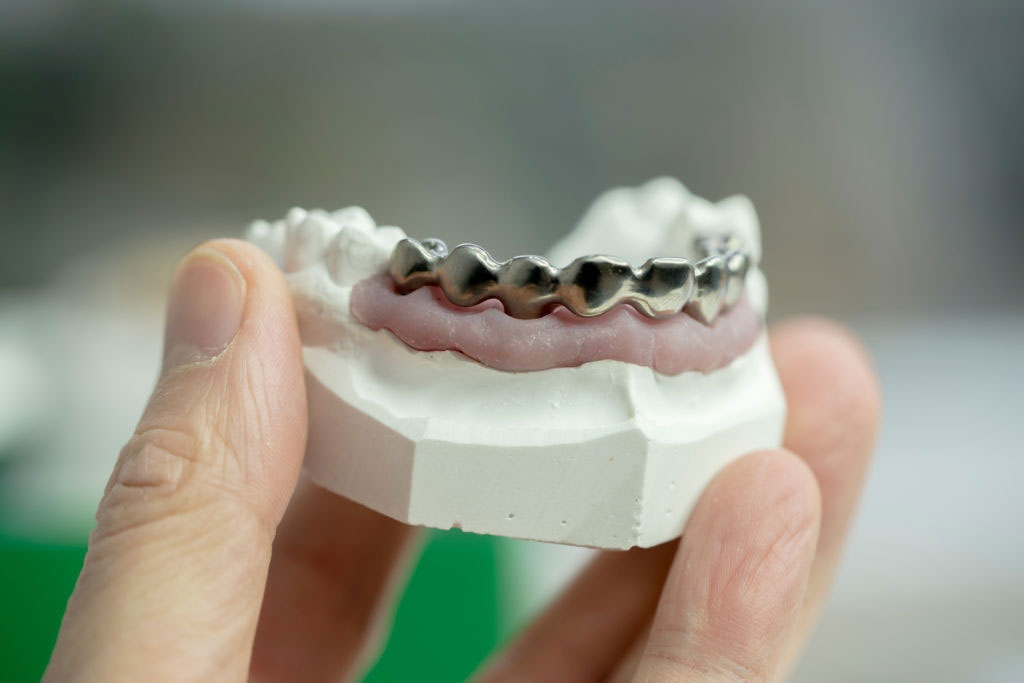
A dental bridge is a fixed dental restoration used to replace one or more missing teeth.
In a conventional bridge, the teeth on either side of the missing space are reshaped and covered with crowns.
An artificial tooth, called a pontic, is connected between those crowns.
The complete restoration is then cemented into position.
How Does a Traditional Dental Bridge Work?
The process usually involves:
- Examination of the supporting teeth
- Preparation of neighbouring teeth
- Impression or digital scan
- Fabrication of the custom bridge
- Fitting and cementation of the final restoration
A fixed dental bridge remains in the mouth and is normally removed only by a dental professional. Pasted text
Dental Implant vs Dental Bridge: What Is the Main Difference?
The biggest difference is how the missing tooth is supported.
| Factor | Dental Implant | Dental Bridge |
|---|---|---|
| Support | Implant placed in jawbone | Usually neighbouring teeth |
| Adjacent teeth | Usually not prepared | Usually need crown preparation |
| Surgery | Required | Usually no implant surgery |
| Treatment time | Usually longer | Often shorter |
| Bone requirement | Important | Implant-level bone not required |
| Cleaning | Around individual implant crown | Requires cleaning underneath bridge |
| Tooth decay | Implant cannot develop decay | Supporting teeth can develop decay |
| Tooth replacement | Independent replacement | Connected restoration |
| Healing | Implant integration required | No implant osseointegration |
| Maintenance | Implant and surrounding tissues monitored | Bridge and supporting teeth monitored |
The original comparison correctly notes that neither option should be selected based on this table alone, because the overall condition of the mouth needs to be considered. Pasted text
Benefits of a Dental Implant for a Missing Tooth
Dental implants offer several potential advantages for suitable patients.
1. Does Not Usually Require Preparation of Healthy Adjacent Teeth
One of the most important benefits of a single implant is that the neighbouring teeth usually do not need to be reshaped simply to support the replacement tooth.
This can be especially valuable when the teeth next to the gap are healthy, intact and free of large restorations.
In a conventional bridge, those teeth generally need to be prepared for crowns.
2. Replaces the Missing Tooth Independently
A dental implant obtains support from the jawbone rather than from neighbouring teeth.
This allows the missing tooth to be restored independently.
3. The Implant Itself Cannot Develop Tooth Decay
An implant does not develop cavities in the same way a natural tooth can.
However, this does not mean implant treatment is maintenance-free.
The tissues around an implant can still become inflamed or diseased, and the crown or other components may require repair or replacement over time. Pasted text
4. Can Provide Long-Term Tooth Replacement
Dental implants can provide long-term function when they are:
- Properly planned
- Correctly positioned
- Properly restored
- Well maintained
- Supported by healthy gums and bone
However, no implant should be considered guaranteed for life.
Regular dental maintenance is still required.
5. Can Help Preserve Healthy Neighbouring Teeth
If the teeth next to the missing space are healthy, an implant allows them to remain untouched.
This is one reason implants are often discussed when replacing a single missing tooth between healthy teeth.
Limitations of Dental Implants
Dental implants are not suitable for every patient.
Important considerations include:
- Surgery is required
- Adequate jawbone is needed
- Healthy surrounding tissues are important
- Healing makes treatment longer
- Bone grafting may sometimes be required
- Certain health conditions may affect treatment
- Implant complications can occur
- Long-term professional maintenance is necessary
The original blog also notes that implant treatment may have a higher initial treatment cost than some alternatives. Pasted text
Benefits of a Dental Bridge for a Missing Tooth
Dental bridges remain an established and useful tooth-replacement option.
1. No Implant Surgery
A conventional dental bridge does not require placement of an implant within the jawbone.
This may be useful for patients who:
- Prefer to avoid implant surgery
- Are not suitable for implant placement
- Have other clinical factors that make implant treatment inappropriate
2. Treatment Can Be Faster
A bridge can often be completed more quickly because there is no implant healing or osseointegration period.
The exact treatment time varies according to the complexity of the case.
3. Can Be Useful When Adjacent Teeth Already Need Crowns
If the teeth on either side of the missing space already have large restorations or significant structural problems and require crowns anyway, using them as bridge supports may sometimes be a reasonable treatment approach. Pasted text
4. Provides a Fixed Replacement
A bridge is cemented into the mouth.
For patients who prefer a fixed restoration rather than a removable option, this can be an advantage.
Limitations of Dental Bridges
The main limitation of a conventional bridge is that it depends on the neighbouring teeth for support.
Healthy Neighbouring Teeth Usually Need to Be Reshaped
The supporting teeth are generally prepared for crowns.
This process is irreversible.
That becomes particularly important when those teeth were previously healthy and unrestored.
Supporting Teeth Can Still Develop Dental Problems
Natural teeth underneath a bridge can still develop:
- Tooth decay
- Gum disease
- Root canal problems
- Structural damage
- Fractures
The condition of the supporting teeth plays a major role in the long-term prognosis of the bridge.
Cleaning Requires Extra Attention
Because the replacement tooth is connected to the crowns beside it, normal floss cannot simply pass vertically between those connected teeth.
Special cleaning methods may include:
- Floss threaders
- Super floss
- Interdental brushes
- Water flossers
- Other cleaning aids recommended by the dentist
Plaque and food should be carefully removed beneath the artificial tooth. Pasted text
Dental Implant vs Bridge: Which Lasts Longer?
There is no universal lifespan that applies to every implant or bridge.
Both can provide many years of function when correctly selected and well maintained.
Factors That Influence Implant Longevity
These include:
- Gum health
- Bone health
- Oral hygiene
- Smoking
- Implant position
- Bite forces
- Medical conditions
- Prosthetic design
- Professional maintenance
Factors That Influence Bridge Longevity
Bridge longevity may depend on:
- Health of supporting teeth
- Risk of tooth decay
- Gum health
- Oral hygiene
- Bite forces
- Quality of the restoration
- Condition of the cement seal
- Existing root canal treatments
Instead of choosing between a dental implant vs dental bridge based on an advertised lifespan, the entire restoration and surrounding tissues should be assessed.
Dental Implant vs Bridge: Which Looks More Natural?
Both dental implants and bridges can produce natural-looking results.
The final appearance depends on several factors:
- Location of the missing tooth
- Shape of the gums
- Amount of bone
- Colour of neighbouring teeth
- Restoration material
- Position of nearby teeth
- Smile line
- Quality of treatment planning
Front Tooth Replacement Requires Special Planning
Replacing a front tooth can be especially demanding.
The dentist must consider not just the tooth, but also:
- Gum contour
- Tooth proportions
- Smile symmetry
- Lip position
- Bone support
- Colour matching
Aesthetic success depends on the overall treatment plan rather than the restoration type alone.
Dental Implant vs Bridge: Which Is Easier to Clean?
Both treatments require good oral hygiene.
Cleaning a Dental Implant
An implant-supported crown is usually cleaned similarly to an individual tooth, although special cleaning methods may sometimes be recommended around the implant.
Patients may need to use:
- Toothbrush
- Interdental brushes
- Implant-safe floss
- Water flosser if recommended
Cleaning a Dental Bridge
A dental bridge requires cleaning underneath the replacement tooth.
Because the teeth are connected, normal flossing between them is different.
Special cleaning aids may be required.
The original article correctly highlights this as an important maintenance difference. Pasted text
What If There Is Bone Loss Around the Missing Tooth?
Jawbone quantity and anatomy are particularly important when considering a dental implant.
If there is not enough bone to support an implant, bone grafting or augmentation may sometimes be recommended.
However, bone loss does not automatically mean implant treatment is impossible.
A dentist may use:
- Clinical examination
- Dental X-rays
- CBCT imaging
to determine whether implant placement is possible and whether additional procedures are required. Pasted text
Dental Implant vs Bridge: Which Is Faster?
A conventional bridge is usually completed faster than a dental implant.
Why?
Implant treatment often includes:
- Implant placement
- Healing period
- Osseointegration
- Final restoration
A bridge does not require implant integration.
However, the actual treatment duration depends on the patient.
Factors that may affect implant treatment time include:
- Extraction
- Bone grafting
- Healing response
- Implant stability
- Gum condition
- Need for temporary teeth
Dental Implant vs Bridge: Which Is More Comfortable?
Both can feel comfortable when correctly planned and fitted.
A dental implant behaves like an individually supported replacement tooth.
A bridge feels like a connected group of teeth.
Comfort depends on:
- Bite
- Fit
- Gum health
- Tooth shape
- Restoration design
- Cleaning access
- Patient adaptation
Neither option is automatically more comfortable for every patient.
Dental Implant vs Bridge: Which Is Better for Healthy Adjacent Teeth?
If the teeth next to the gap are healthy and unrestored, preserving them is an important consideration.
A single-tooth implant may be discussed because those neighbouring teeth do not usually need to be prepared.
However, this does not automatically mean an implant is the right choice.
Other factors must still be considered, including:
- Bone availability
- Medical history
- Gum health
- Bite
- Aesthetic demands
- Surgical suitability
- Personal preferences
Dental Implant vs Bridge: Which Is Better If Adjacent Teeth Are Already Damaged?
If the neighbouring teeth already require crowns because of:
- Large fillings
- Fractures
- Significant wear
- Structural weakness
then a bridge may sometimes become a more reasonable option.
In such a situation, preparing the teeth for crowns may already be necessary.
This is one reason why the condition of the adjacent teeth is one of the most important factors in deciding between an implant and bridge.
Dental Implant vs Bridge: How Does a Dentist Decide?
The decision should be individualized.
A dentist may evaluate:
- Number of missing teeth
- Location of the gap
- Condition of neighbouring teeth
- Available jawbone
- Gum health
- Bite
- Tooth position
- Existing crowns
- Existing fillings
- Medical history
- Smoking or tobacco use
- Oral hygiene
- Aesthetic requirements
- Treatment timeline
- Long-term maintenance needs
- Personal preferences
- Budget
The original article particularly emphasizes the health of the neighbouring teeth. Healthy unrestored teeth may make an implant worth discussing, while adjacent teeth that already need crowns may change the treatment plan. Pasted text
What Happens If a Missing Tooth Is Not Replaced?
Not every missing tooth produces the same long-term effects.
The consequences depend on:
- Location of the missing tooth
- Bite
- Condition of neighbouring teeth
- Opposing teeth
- Chewing pattern
In some cases, a missing tooth may contribute to:
- Tilting of neighbouring teeth
- Tooth movement
- Changes in bite
- Opposing tooth movement
- Changes in chewing function
A dentist can determine whether replacement is advisable for a particular missing tooth.
Dental Implant vs Dental Bridge for Front Tooth Replacement
Front tooth replacement often has high aesthetic demands.
Factors to consider include:
- Gum line
- Smile line
- Bone volume
- Tooth colour
- Shape of adjacent teeth
- Space
- Lip position
A dental implant can replace the tooth independently, while a bridge relies on neighbouring teeth.
The final choice depends heavily on the condition of the gums, bone and adjacent teeth.
Dental Implant vs Dental Bridge for Back Tooth Replacement
Back teeth experience strong chewing forces.
When replacing a molar or premolar, the dentist may evaluate:
- Bite force
- Bone availability
- Condition of adjacent teeth
- Space
- Gum health
- Chewing pattern
The treatment must be designed to withstand functional loading.
Dental Implant vs Bridge: What About Cost?
Cost is an important factor for many patients, but it should not be considered in isolation.
The total cost can depend on:
- Diagnostic imaging
- Need for extraction
- Bone grafting
- Implant components
- Type of crown
- Bridge material
- Condition of adjacent teeth
- Need for root canal treatment
- Number of appointments
- Long-term maintenance
A treatment that seems less expensive initially may have different long-term maintenance requirements.
For this reason, the comparison should include both the initial treatment and the long-term health of the supporting structures.
Is a Dental Implant Better Than a Bridge?
Not always.
A dental implant may be attractive when:
- Adjacent teeth are healthy
- Adequate bone is available
- Surgery is appropriate
- Independent tooth replacement is preferred
A bridge may be appropriate when:
- Adjacent teeth already require crowns
- Implant surgery is not suitable
- Faster treatment is preferred
- Implant treatment is declined
The decision should be based on the individual clinical situation rather than a universal rule.
Does a Bridge Damage the Teeth Next to It?
A conventional bridge requires the supporting teeth to be reshaped for crowns.
This is an irreversible process.
However, describing this automatically as “damage” can be misleading.
If the teeth already require crowns, preparing them as bridge supports may be clinically reasonable.
The important issue is whether those neighbouring teeth are healthy or already need restorative treatment.
Can You Get an Implant Immediately After Tooth Extraction?
Sometimes.
Immediate implant placement is possible in selected cases.
However, not every extraction site is suitable.
The dentist may assess:
- Bone condition
- Infection
- Gum health
- Anatomy
- Implant stability
- Position of nearby structures
In some cases, delayed implant placement may be more appropriate.
Can a Dental Bridge Be Replaced With an Implant Later?
Sometimes.
Before replacing a bridge with an implant, the dentist needs to evaluate:
- Supporting teeth
- Bone availability
- Size of the missing-tooth space
- Gum condition
- Bite
- Previous treatment
Changing from a bridge to an implant is not automatically possible in every case.
Can Dental Implants Get Cavities?
No.
The implant itself cannot develop tooth decay.
However, plaque accumulation around an implant can still affect the surrounding gums and bone.
Proper cleaning and professional maintenance remain essential.
Can Teeth Under a Bridge Get Cavities?
Yes.
The supporting natural teeth remain vulnerable to decay.
This is why good cleaning around the bridge margins is important.
If decay develops underneath a bridge, treatment may become more complex.
Dental Implant vs Dental Bridge: AEO Quick Comparison
Which option preserves neighbouring teeth?
A dental implant usually preserves healthy adjacent teeth because they do not need to be prepared as supports.
Which option is faster?
A conventional bridge is usually faster because implant healing is not required.
Which option needs surgery?
A dental implant requires surgery.
A traditional bridge usually does not.
Which option needs more bone?
A dental implant requires adequate jawbone.
A bridge does not depend on implant-level bone.
Which option is easier to floss?
An implant-supported crown is generally cleaned like an individual tooth, while a bridge requires cleaning underneath the pontic.
Which option is better if adjacent teeth already need crowns?
A bridge may sometimes be more appropriate if those teeth already require significant restorative treatment.
Dental Implant vs Dental Bridge in Pune
If you are considering a dental implant vs dental bridge in Pune, the right treatment depends on more than simply replacing the missing tooth.
A detailed assessment should consider:
- Jawbone
- Gum health
- Adjacent teeth
- Bite
- Existing restorations
- Medical history
- Aesthetic goals
At Novacare Dental, Kothrud, Pune, patients with missing teeth can be evaluated to understand whether a dental implant, dental bridge, or another tooth-replacement option may be appropriate.
If implant treatment is being considered, you can also read the guide on choosing a dental implant specialist in Pune for additional information about implant planning and treatment selection.
Frequently Asked Questions
Is a dental implant better than a dental bridge?
Not in every situation. An implant replaces the missing tooth independently, while a bridge uses neighbouring teeth for support. The better option depends on bone, gum health, adjacent teeth, medical history and treatment goals.
Is a dental implant more painful than a bridge?
Implant placement involves surgery performed with anaesthesia and a healing period. A bridge requires preparation of supporting teeth. The amount of discomfort varies between patients.
Which lasts longer: implant or bridge?
Both can provide long-term service when properly planned and maintained. Longevity depends on oral hygiene, bite, gum health, supporting structures and other factors.
Does a bridge damage healthy teeth?
A conventional bridge requires neighbouring teeth to be permanently prepared for crowns. This is important when those teeth are otherwise healthy.
Can an implant be placed immediately after extraction?
In selected cases, yes. Bone condition, infection, anatomy and implant stability need to be evaluated.
Which looks more natural: implant or bridge?
Both can look natural. The result depends on gum shape, bone, tooth colour, smile line, restoration quality and treatment planning.
Which is easier to clean?
An implant crown is generally cleaned like an individual tooth, while a bridge requires special cleaning underneath the connected replacement tooth.
Can implants fail?
Yes. Implant complications and failure are possible. Good planning, hygiene and maintenance are important.
Can a bridge fail?
Yes. Bridge failure may occur due to decay, gum disease, structural problems, cement failure or problems with supporting teeth.
Can an implant get a cavity?
No. The implant itself cannot develop tooth decay, but surrounding gums and bone can still develop inflammatory disease.
Can a tooth under a bridge decay?
Yes. Supporting natural teeth can still develop cavities.
Which is faster: implant or bridge?
A conventional bridge is usually faster because implant healing is not required.
Is bone grafting always needed for an implant?
No. Bone grafting is recommended only when there is insufficient bone for the planned implant placement.
What if I have bone loss?
Bone loss does not automatically prevent implant treatment. Imaging and clinical examination are needed to determine whether grafting or another approach is required.
Which option is better if the neighbouring teeth are healthy?
Preserving healthy adjacent teeth is an important consideration and may make a single implant worth discussing, but other factors such as bone, health and bite still need assessment.
Which option is better if the neighbouring teeth already need crowns?
A bridge may sometimes be a reasonable option because those teeth already require restorative coverage.
Can I replace an old bridge with implants?
Sometimes. The dentist must first assess bone, gum health, neighbouring teeth and the available space.
Conclusion
When comparing a dental implant vs dental bridge, there is no universally better option.
A dental implant can replace the missing tooth independently and usually avoids preparing healthy neighbouring teeth.
However, it requires:
- Surgery
- Adequate jawbone
- Healing time
- Long-term implant maintenance
A dental bridge can replace the tooth without implant surgery and can often be completed faster.
It may also be particularly useful when adjacent teeth already require crowns.
However, a conventional bridge depends on neighbouring teeth for support and requires those teeth to be prepared.
The most appropriate choice depends on:
- Oral health
- Bone availability
- Gum health
- Condition of adjacent teeth
- Bite
- Medical history
- Treatment timeline
- Aesthetic needs
- Long-term maintenance
- Personal preferences
At Novacare Dental, Kothrud, Pune, patients with a missing tooth can receive an individualized assessment to understand whether a dental implant, dental bridge, or another tooth-replacement option is appropriate.
Missing a Tooth?
If you are trying to decide between a dental implant vs dental bridge, book a consultation with Novacare Dental, Kothrud, Pune for an evaluation based on your specific dental condition.
This article is intended for general educational information and should not replace an individual dental examination, diagnosis or treatment recommendation.