A dental emergency is an oral or dental problem that requires prompt professional attention because delaying treatment may increase pain, worsen an infection, cause uncontrolled bleeding, damage surrounding tissues, or reduce the possibility of saving a tooth.
Common dental emergencies include severe toothache, dental abscess, facial swelling, a knocked-out permanent tooth, badly fractured teeth, uncontrolled oral bleeding, dental trauma and serious complications following a tooth extraction.
Not every dental problem requires immediate emergency treatment. Mild sensitivity, a small painless chip or a minor cosmetic concern may usually be managed through a scheduled dental appointment.
However, symptoms such as severe pain, swelling, fever, trauma, persistent bleeding or rapidly worsening symptoms should not be ignored.
If you are experiencing a dental emergency in Pune, particularly severe tooth pain, swelling, dental trauma or infection, contacting a dentist promptly can help determine the cause and appropriate next step.
Quick Answer: What Is Considered a Dental Emergency?
A dental problem is generally considered urgent when delaying treatment could significantly worsen:
- Pain
- Infection
- Swelling
- Bleeding
- Dental trauma
- Tooth damage
- The possibility of saving a tooth
You may need urgent dental care for:
- Severe or persistent toothache
- Dental abscess or tooth infection
- A knocked-out permanent tooth
- A badly broken, cracked or fractured tooth
- Significant facial or gum swelling
- Uncontrolled bleeding from the mouth
- Dental trauma or jaw injury
- Severe pain or bleeding after tooth extraction
Some dental emergencies can be managed by a dentist, while serious facial trauma, breathing difficulties or rapidly spreading swelling may require immediate hospital-level emergency medical care.
What Is a Dental Emergency?
A dental emergency is not simply any discomfort involving the teeth or gums.
Dentists generally assess urgency according to the severity of symptoms, the cause of the problem, whether infection is present, the amount of bleeding, whether trauma has occurred and whether delaying treatment could cause further damage.
For example, a slightly chipped tooth without pain may not require treatment within the next few hours.
A knocked-out adult tooth, however, is highly time-sensitive and should receive immediate professional attention.
Similarly, mild gum irritation may be evaluated during a routine appointment, while rapidly increasing facial swelling associated with dental infection requires urgent assessment.
Understanding these differences can help patients decide whether they need routine dental treatment, urgent dental care or emergency medical assistance.
1. Severe or Persistent Toothache
A severe toothache is one of the most common reasons patients seek emergency dental treatment.
Tooth pain is a symptom rather than a diagnosis. This means that relieving the pain temporarily does not necessarily resolve the underlying dental problem.
A dentist needs to identify the cause before recommending appropriate treatment.
What Causes Severe Tooth Pain?
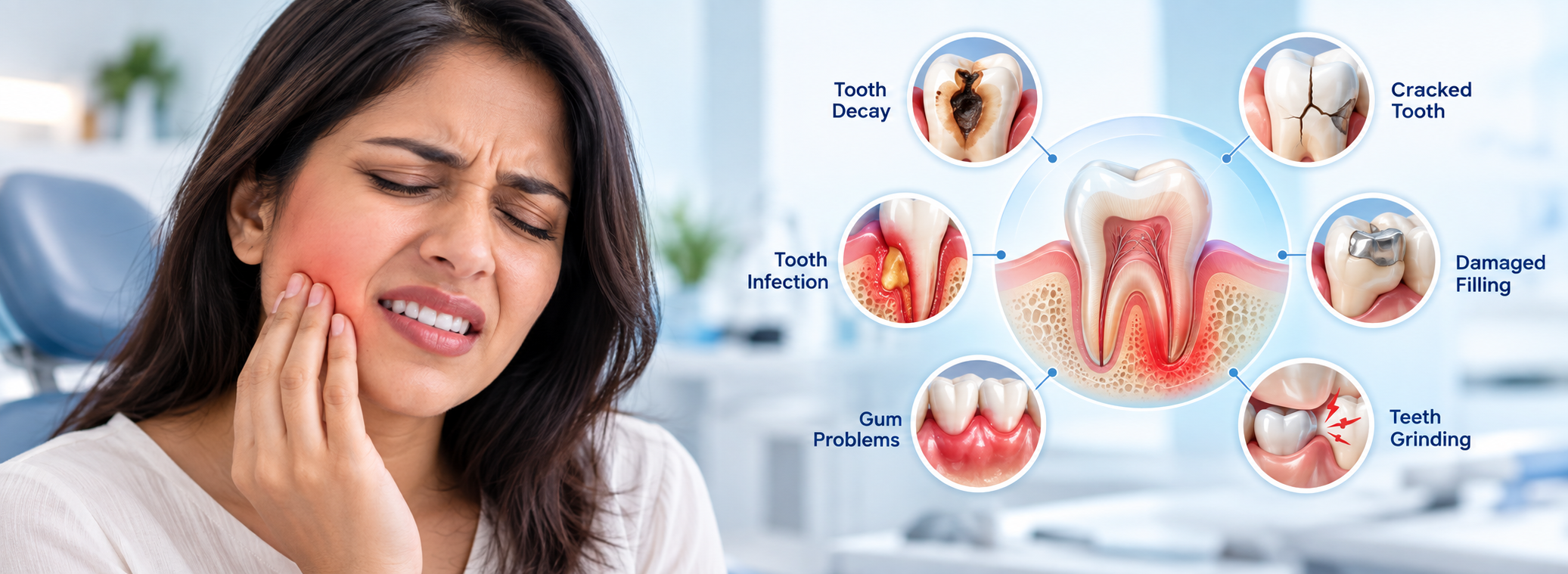
Possible causes include:
- Deep tooth decay
- Dental pulp inflammation
- Tooth infection
- Dental abscess
- Cracked or fractured tooth
- Damaged filling
- Loose or damaged restoration
- Gum infection
- Periodontal problems
- Dental trauma
- Pressure around an impacted tooth
The intensity of pain can vary depending on the underlying cause.
Some patients experience constant throbbing pain, while others notice sharp pain when chewing, drinking something cold or applying pressure to a tooth.
When Is Toothache a Dental Emergency?
Seek prompt dental attention if the toothache:
- Is severe or persistent
- Prevents you from sleeping
- Interferes with eating or daily activities
- Becomes progressively worse
- Cannot be adequately controlled
- Occurs with facial swelling
- Occurs with gum swelling
- Is associated with fever
- Causes severe pain while biting
- Is accompanied by pus or an unpleasant taste
These symptoms may indicate inflammation or infection that requires professional evaluation.
Can Severe Toothache Go Away on Its Own?
Sometimes dental pain temporarily decreases, but that does not necessarily mean the underlying problem has resolved.
For example, pain associated with severe dental pulp damage may change over time even though infection or structural damage remains.
Therefore, persistent or recurring toothache should be evaluated rather than repeatedly treated only with temporary home remedies.
If you are experiencing persistent tooth pain, your dentist may evaluate the tooth using a clinical examination and, when required, dental imaging to determine whether treatment such as restoration, root canal therapy, periodontal treatment or extraction is appropriate.
2. Dental Abscess or Tooth Infection
A dental abscess is a collection of pus caused by a bacterial infection involving a tooth or the surrounding tissues.
Dental abscesses require prompt assessment because the source of the infection generally needs professional dental treatment.
Ignoring an infection may allow pain or swelling to worsen.
What Are the Symptoms of a Dental Abscess?
Possible warning signs include:
- Severe toothache
- Throbbing dental pain
- Tender or swollen gums
- Facial swelling
- Jaw swelling
- Pain while chewing
- Pain when biting
- Pus or drainage
- Unpleasant taste in the mouth
- Difficulty opening the mouth
- Fever
- Swollen lymph nodes
- Feeling generally unwell
The symptoms can vary depending on where the infection is located and how advanced it has become.
Is a Dental Abscess an Emergency?
A dental abscess needs prompt dental evaluation.
The urgency becomes greater if swelling is increasing, spreading into the face or neck, or is accompanied by fever or systemic symptoms.
If swelling causes difficulty breathing or swallowing, emergency medical assessment is required.
How Is a Dental Abscess Treated?
Treatment depends on the source and extent of infection.
A dentist may recommend treatment such as:
- Drainage of infection
- Root canal treatment
- Treatment of the affected gum tissue
- Extraction when a tooth cannot be predictably restored
- Other treatment depending on the diagnosis
Antibiotics may sometimes be prescribed depending on the clinical situation, but medication alone may not remove the underlying dental cause.
This is one reason patients should avoid taking antibiotics left over from previous illnesses or medications prescribed to another person.
Professional diagnosis is important.
3. Knocked-Out Permanent Tooth
A knocked-out permanent tooth is known as an avulsed tooth.
This is one of the most time-sensitive dental emergencies.
Acting quickly may improve the possibility of successfully repositioning and saving the tooth.
What Should You Do If a Permanent Tooth Gets Knocked Out?
If an adult permanent tooth has been knocked out:
- Pick up the tooth by the crown, which is the white portion normally visible in the mouth.
- Avoid touching the root.
- If the tooth is dirty, rinse it gently without aggressively scrubbing it.
- Do not scrape or remove tissue attached to the root.
- If appropriate and possible, gently reposition the tooth into the socket.
- If repositioning is not possible, keep the tooth moist.
- Milk or an appropriate tooth-preservation medium may be used.
- Seek emergency dental treatment immediately.
Time matters in this situation.
Do not delay treatment while waiting to see whether pain improves.
Should You Put a Baby Tooth Back Into the Socket?
No.
A knocked-out baby tooth should generally not be reinserted, because doing so could potentially affect the developing permanent tooth underneath.
The child should still receive professional dental assessment, especially if there has been significant trauma.
When Should You Contact an Emergency Dentist?
Immediately.
A knocked-out permanent tooth should receive urgent professional attention because treatment becomes more difficult as time passes.
Sports injuries, falls, accidents and impact injuries are common causes of dental avulsion.
Patients involved in contact sports can reduce the risk of serious dental trauma by wearing an appropriately fitted mouthguard.
4. Broken, Cracked or Fractured Tooth
Not every chipped tooth is an emergency.
A small superficial chip without pain may sometimes be managed during a regular dental appointment.
A significantly broken or fractured tooth, however, requires prompt assessment when deeper tooth structure is exposed or symptoms are severe.
When Is a Broken Tooth a Dental Emergency?
Urgent assessment may be necessary when the broken tooth causes:
- Severe pain
- Bleeding
- Sensitivity
- Sharp exposed edges
- Visible internal tooth structure
- Difficulty chewing
- Facial trauma
- Swelling
- Significant loss of tooth structure
Trauma affecting a tooth can also injure the root, surrounding bone or nearby gum tissue, even when the visible damage initially appears limited.
What Should You Do With a Broken Tooth?
Until you reach a dentist:
- Rinse your mouth gently with clean water
- Avoid chewing on the affected side
- Keep any tooth fragments you find
- Avoid trying to repair the tooth yourself
- Apply a cold compress externally if facial swelling occurs
- Arrange professional assessment
Avoid placing chemicals, household adhesive or other substances onto the tooth.
How Is a Broken Tooth Treated?
Treatment depends on how deeply the tooth has fractured.
Options may include:
- Dental bonding
- Tooth-coloured restoration
- Dental filling
- Dental crown
- Root canal treatment
- Other restorative treatment
- Extraction when the tooth cannot be predictably restored
Early evaluation can help determine whether the tooth can be preserved.
5. Facial or Gum Swelling
Dental swelling should not be ignored, especially when it is increasing.
Swelling may arise from:
- Tooth infection
- Dental abscess
- Gum infection
- Impacted tooth
- Oral inflammation
- Trauma
- Other dental or oral conditions
Small localised gum swelling may not always represent an immediate emergency, but significant facial swelling requires professional evaluation.
When Does Dental Swelling Become Dangerous?
Seek urgent assessment if swelling is:
- Rapidly increasing
- Spreading across the face
- Extending towards the neck
- Associated with severe pain
- Accompanied by fever
- Making it difficult to open your mouth
- Causing significant discomfort
- Associated with feeling generally unwell
When Should Facial Swelling Go to a Hospital?
Seek immediate emergency medical attention if swelling causes:
- Difficulty breathing
- Difficulty swallowing
- Difficulty speaking
- Rapid progression around the face or neck
- Signs of severe systemic illness
These symptoms should not wait for a routine dental appointment.
Can Dental Swelling Be Treated at Home?
Home measures may temporarily reduce discomfort but cannot reliably eliminate the underlying cause of significant dental swelling.
Applying random medicines, delaying treatment or relying only on temporary pain relief can allow the problem to worsen.
The correct approach is to identify why the swelling has developed.
6. Uncontrolled Bleeding From the Mouth
Minor oral bleeding can occur after some dental procedures or minor injuries.
However, heavy or persistent bleeding that cannot be controlled requires urgent assessment.
What Can Cause Oral Bleeding?
Possible causes include:
- Dental trauma
- Recent tooth extraction
- Gum injury
- Tongue injury
- Soft-tissue injury
- Dental surgery complications
- Certain medical conditions
- Medications affecting blood clotting
What Should You Do About Dental Bleeding?
If bleeding occurs following dental treatment, follow the post-operative instructions given by your dentist.
After extraction, instructions may include applying firm pressure using clean gauze for the recommended period.
Avoid repeatedly checking or disturbing the extraction area unnecessarily.
When Is Dental Bleeding an Emergency?
Seek urgent care when:
- Bleeding is heavy
- Bleeding continues despite recommended local pressure
- Blood loss appears significant
- The bleeding follows serious trauma
- You feel weak, dizzy or significantly unwell
- You are taking medication that affects blood clotting and cannot control the bleeding
Heavy bleeding that cannot be controlled may require emergency medical assessment.
7. Dental Trauma or Jaw Injury
Dental trauma may result from:
- Falls
- Sports injuries
- Road accidents
- Workplace accidents
- Direct impact to the face
- Other physical injuries
Trauma can affect much more than one tooth.
It may involve:
- Teeth
- Tooth roots
- Gums
- Lips
- Jawbone
- Facial bones
- Soft tissues
What Dental Problems Can Trauma Cause?
Dental trauma may result in:
- Loose teeth
- Displaced teeth
- Broken teeth
- Fractured teeth
- Knocked-out teeth
- Gum injuries
- Cuts inside the mouth
- Jaw pain
- Bite changes
- Facial swelling
When Does Dental Trauma Need Emergency Treatment?
Prompt assessment is important if:
- A tooth has moved from its normal position
- A tooth has been knocked out
- The tooth is badly fractured
- The bite suddenly feels different
- Several teeth are injured
- There is uncontrolled bleeding
- Significant facial swelling develops
Some dental injuries may appear minor externally while deeper structures have still been damaged.
When Should Jaw Trauma Go to the Hospital?
Emergency medical evaluation is appropriate for:
- Suspected jaw fracture
- Severe facial injury
- Significant head injury
- Loss of consciousness
- Difficulty breathing
- Heavy uncontrolled bleeding
Dental treatment can then be coordinated after the patient is medically stable.
8. Severe Pain or Bleeding After Tooth Extraction
Some discomfort after a tooth extraction is expected.
Mild soreness, swelling and small amounts of bleeding may occur depending on the procedure.
However, symptoms that are severe, increasing or outside the recovery instructions given by your dentist should be assessed.
Warning Signs After Tooth Extraction
Contact your dentist promptly if you experience:
- Severe or increasing pain
- Bleeding that does not stop
- Increasing facial swelling
- Fever
- Feeling significantly unwell
- Pus
- Unpleasant discharge
- Persistent bad taste
- Symptoms your dentist specifically instructed you to report
What Is Dry Socket?
Severe pain after extraction can have several causes.
One possible complication is dry socket, which can develop after a tooth extraction and typically requires professional assessment and management.
Patients should not try to diagnose post-extraction complications themselves.
If pain becomes significantly worse rather than gradually improving, contact the dental clinic that performed the procedure.
Dental Emergency vs Routine Dental Problem: What’s the Difference?
One of the most common patient questions is:
“Do I need an emergency dentist, or can I wait?”
The answer depends primarily on severity, progression and risk.
Problems That May Often Be Routine
Examples can include:
- Small painless tooth chip
- Mild sensitivity
- Minor cosmetic damage
- Slight staining
- Stable dental issue without pain or swelling
These should still be evaluated, but they may not always require same-day emergency treatment.
Problems That Require Urgent Dental Assessment
Urgent care should be considered when symptoms include:
- Severe tooth pain
- Persistent pain
- Significant swelling
- Infection
- Dental abscess
- Knocked-out tooth
- Significant fracture
- Trauma
- Uncontrolled bleeding
- Rapidly worsening symptoms
When in doubt, contact a dental clinic and clearly explain your symptoms.
The dental team can advise whether you require immediate evaluation or a scheduled appointment.
What Should You Do During a Dental Emergency?
During a dental emergency, staying calm and taking the correct first steps can help reduce additional damage.
Step 1: Contact a Dentist
Provide clear information about:
- What happened
- Which tooth or area is affected
- When the symptoms started
- How severe the pain is
- Whether swelling is present
- Whether swelling is increasing
- Whether you have a fever
- Whether an injury occurred
- Whether bleeding is present
- Whether bleeding can be controlled
This information helps the dental team understand how urgently you may need assessment.
Step 2: Protect the Injured Area
Depending on the situation:
- Avoid chewing on a fractured tooth
- Keep a knocked-out permanent tooth moist
- Apply clean gauze for bleeding when advised
- Use an external cold compress for swelling after trauma
- Preserve broken tooth fragments if possible
Step 3: Seek Professional Care
Temporary symptom relief should not replace professional diagnosis.
A dental emergency usually requires identifying and treating the underlying cause.
What Should You Avoid During a Dental Emergency?
Avoid actions that could worsen the problem.
Do not:
- Delay treatment while symptoms are worsening
- Place aspirin directly on a tooth or gum
- Attempt to repair a broken tooth yourself
- Use glue on a broken tooth
- Place sharp objects around the affected area
- Scrub the root of a knocked-out tooth
- Take another person’s prescription medication
- Use leftover antibiotics without professional advice
A temporary reduction in pain does not always mean the dental problem has resolved.
When Should You Go to a Hospital Instead of a Dentist?
Most tooth-related dental emergencies should be assessed by a dentist.
However, certain symptoms may require immediate emergency medical care.
Go to a hospital or emergency medical facility when you experience:
- Difficulty breathing
- Difficulty swallowing
- Severe or rapidly spreading facial swelling
- Neck swelling affecting breathing or swallowing
- Heavy bleeding that cannot be controlled
- Serious facial trauma
- Suspected jaw fracture
- Loss of consciousness after an injury
- Significant symptoms suggesting serious systemic illness
These situations can extend beyond routine dental treatment.
Once immediate medical risks have been managed, dental care may also be required.
How Can Dental Emergencies Be Prevented?
Not every dental emergency can be prevented.
Accidents can happen unexpectedly.
However, several preventive habits can reduce your risk of developing urgent dental problems.
1. Attend Regular Dental Check-Ups
Routine dental examinations can help detect:
- Dental decay
- Cracked teeth
- Gum disease
- Loose restorations
- Damaged fillings
- Early infection
- Other oral health concerns
Early treatment may prevent some problems from becoming painful emergencies.
2. Do Not Ignore Persistent Tooth Pain
Recurring tooth pain should not be considered normal.
Even when the pain disappears temporarily, the cause should be assessed.
3. Replace Damaged Dental Restorations
Broken fillings, damaged crowns and loose restorations should be evaluated before they lead to more extensive tooth damage.
4. Wear a Mouthguard During Sports
People participating in contact sports or activities where facial injuries are possible may benefit from a properly fitted mouthguard.
5. Avoid Using Teeth as Tools
Do not use your teeth to:
- Open packaging
- Crack hard objects
- Cut materials
- Open bottle caps
- Bite non-food objects
These habits can fracture or chip teeth.
6. Do Not Ignore Gum Swelling
Recurring gum swelling, bleeding or pus may indicate an underlying dental or periodontal problem.
7. Follow Post-Extraction Instructions
If you have undergone tooth extraction, wisdom tooth removal or oral surgery, carefully follow the recovery instructions provided by your dentist.
Emergency Dentist in Pune: When Should You Book an Appointment?
If you are searching for an emergency dentist in Pune, contact a dental clinic when symptoms include:
- Severe toothache
- Dental abscess
- Facial swelling
- Broken tooth
- Dental trauma
- Knocked-out permanent tooth
- Uncontrolled oral bleeding
- Severe post-extraction pain
- Increasing swelling after dental treatment
Patients should describe their symptoms clearly while contacting the clinic so the dental team can determine how urgently an appointment is required.
Emergency Dental Care in Kothrud, Pune
Patients living in Kothrud and nearby areas may prefer a local dental clinic when urgent assessment is required because travelling long distances while experiencing severe tooth pain, facial swelling or dental trauma can be difficult.
At Novacare Dental, Kothrud, Pune, patients experiencing urgent dental concerns can be assessed to identify the underlying cause and determine an appropriate treatment approach.
Depending on the diagnosis, treatment may involve restorative dentistry, root canal treatment, tooth extraction, management of dental infection or other procedures.
Why Prompt Dental Assessment Matters
Many dental problems become more difficult to manage when treatment is delayed.
For example:
- Tooth decay may progress deeper into the tooth.
- Infection may become more painful.
- Swelling may increase.
- A fractured tooth may lose additional structure.
- A traumatised tooth may have a lower possibility of preservation.
- Bleeding may require professional intervention.
- Post-operative complications may worsen.
This does not mean every dental symptom is dangerous.
It means that severe, progressive or unusual symptoms deserve professional evaluation rather than repeated self-treatment.
Frequently Asked Questions About Dental Emergencies
What qualifies as a dental emergency?
A dental emergency is generally a problem involving severe or persistent pain, significant infection, facial swelling, uncontrolled bleeding, serious trauma, a knocked-out permanent tooth or another condition where delaying treatment could worsen the outcome.
Is severe toothache a dental emergency?
It can be.
Severe tooth pain that interferes with sleep or normal activities, cannot be adequately controlled, becomes progressively worse or occurs with swelling, fever, pain while biting or other signs of infection should receive prompt dental assessment.
Is a dental abscess an emergency?
A dental abscess needs urgent professional dental treatment.
If swelling spreads into the face or neck or causes difficulty breathing or swallowing, immediate emergency medical assessment is required.
What should I do if my permanent tooth is knocked out?
Handle the tooth by the crown rather than the root.
If necessary, rinse it gently without scrubbing.
If appropriate, it may be gently repositioned into the socket.
If this is not possible, keep it moist using milk or an appropriate tooth-preservation medium and seek emergency dental care immediately.
Should I put a child’s knocked-out baby tooth back into the socket?
No.
A knocked-out baby tooth should generally not be reinserted because it may affect the developing permanent tooth.
The child should still receive professional dental assessment following the injury.
Is a broken tooth always a dental emergency?
No.
A small painless chip may not require immediate treatment.
However, a badly fractured tooth associated with severe pain, bleeding, trauma or significant structural damage should receive prompt assessment.
Can I wait until tomorrow if my face is swollen because of a tooth?
Significant or increasing facial swelling should be evaluated promptly.
Do not delay if the swelling is spreading, associated with fever or making it difficult to open your mouth.
Difficulty breathing or swallowing requires immediate emergency medical care.
Is bleeding after tooth extraction normal?
Minor bleeding or oozing can occur after extraction.
However, heavy or persistent bleeding that does not respond to the instructions provided by your dentist needs urgent assessment.
Should I visit a dentist or hospital for a dental emergency?
Most tooth-related emergencies are treated by dentists.
Hospital-level emergency medical care may be necessary for serious facial injuries, suspected jaw fractures, uncontrolled heavy bleeding, loss of consciousness, severe spreading swelling or difficulty breathing or swallowing.
Can a tooth infection go away without treatment?
Symptoms may temporarily improve, but the underlying dental cause may remain.
A suspected tooth infection should be professionally assessed so that appropriate treatment can be determined.
Can emergency dental treatment save a damaged tooth?
In some situations, early dental treatment may improve the possibility of preserving a damaged or traumatised tooth.
The outcome depends on the type and severity of the injury, how quickly treatment is received and the condition of the tooth and surrounding tissues.
What should I do for unbearable tooth pain at night?
If pain is severe, persistent or accompanied by swelling, fever, trauma or other concerning symptoms, contact an emergency dental service or seek appropriate urgent professional care.
Avoid placing aspirin directly on the tooth and avoid using medication prescribed for another person.
What causes sudden severe tooth pain?
Possible causes include deep decay, dental pulp inflammation, infection, abscess, cracked tooth, dental trauma, damaged restorations and gum-related problems.
A clinical examination is necessary to identify the exact cause.
What are the warning signs of a serious dental infection?
Warning signs may include:
- Increasing facial swelling
- Fever
- Severe tooth pain
- Pus or drainage
- Difficulty opening the mouth
- Feeling significantly unwell
- Swelling extending towards the neck
Difficulty breathing or swallowing requires immediate emergency medical assessment.
Can a cracked tooth become worse if untreated?
Yes.
Depending on the location and depth of the crack, additional chewing pressure may cause further damage.
A dentist should assess a painful or significantly cracked tooth and determine whether it can be restored.
How quickly should I see a dentist after dental trauma?
Significant dental trauma should be evaluated as soon as possible.
A knocked-out permanent tooth is particularly time-sensitive and requires immediate dental attention.
AEO Quick Summary: When Do You Need Urgent Dental Care?
You should consider urgent dental care when you have:
- Severe or persistent toothache
- Dental infection or abscess
- Increasing facial swelling
- A knocked-out permanent tooth
- Significant tooth fracture
- Uncontrolled oral bleeding
- Dental or facial trauma
- Severe symptoms after extraction
Seek emergency medical care rather than waiting for a dental appointment if you develop:
- Difficulty breathing
- Difficulty swallowing
- Rapidly spreading facial or neck swelling
- Serious facial or jaw injury
- Uncontrolled heavy bleeding
- Loss of consciousness after trauma
Conclusion
A dental emergency is more than an inconvenient toothache.
Certain problems can threaten a tooth, allow infection to progress, cause significant swelling, lead to uncontrolled bleeding or create complications when treatment is delayed.
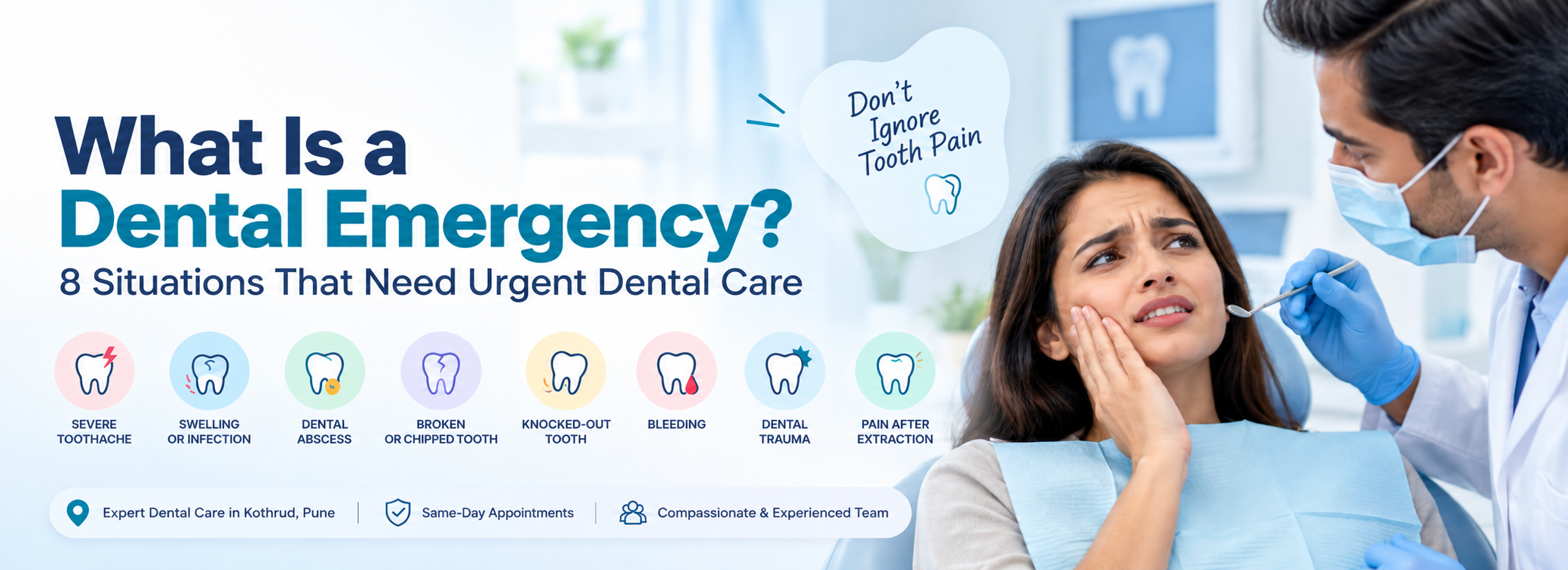
The eight dental situations that commonly require urgent attention are:
- Severe or persistent toothache
- Dental abscess or tooth infection
- Knocked-out permanent tooth
- Broken, cracked or fractured tooth
- Facial or gum swelling
- Uncontrolled oral bleeding
- Dental trauma or jaw injury
- Severe pain or bleeding after tooth extraction
The appropriate response depends on the severity of symptoms.
Mild and stable dental concerns may often be managed through a routine appointment, while severe pain, infection, increasing swelling, trauma or persistent bleeding requires prompt professional assessment.
Symptoms affecting breathing, swallowing or consciousness require immediate emergency medical care.
If you are experiencing severe tooth pain, facial swelling, a broken tooth, dental trauma or another urgent dental problem in Kothrud or Pune, contact Novacare Dental for professional assessment and appropriate dental care.
According to guidance from the American Dental Association, dental injuries such as a knocked-out permanent tooth require prompt professional attention.
The NHS also advises urgent assessment when dental swelling is severe, spreading, or associated with difficulty breathing or swallowing.
Book an Urgent Dental Consultation in Kothrud, Pune
Experiencing severe toothache, swelling, a damaged tooth or another possible dental emergency?
Contact Novacare Dental, Kothrud, Pune to explain your symptoms and arrange an appropriate dental evaluation.
Prompt assessment can help identify the underlying problem and determine the treatment required.