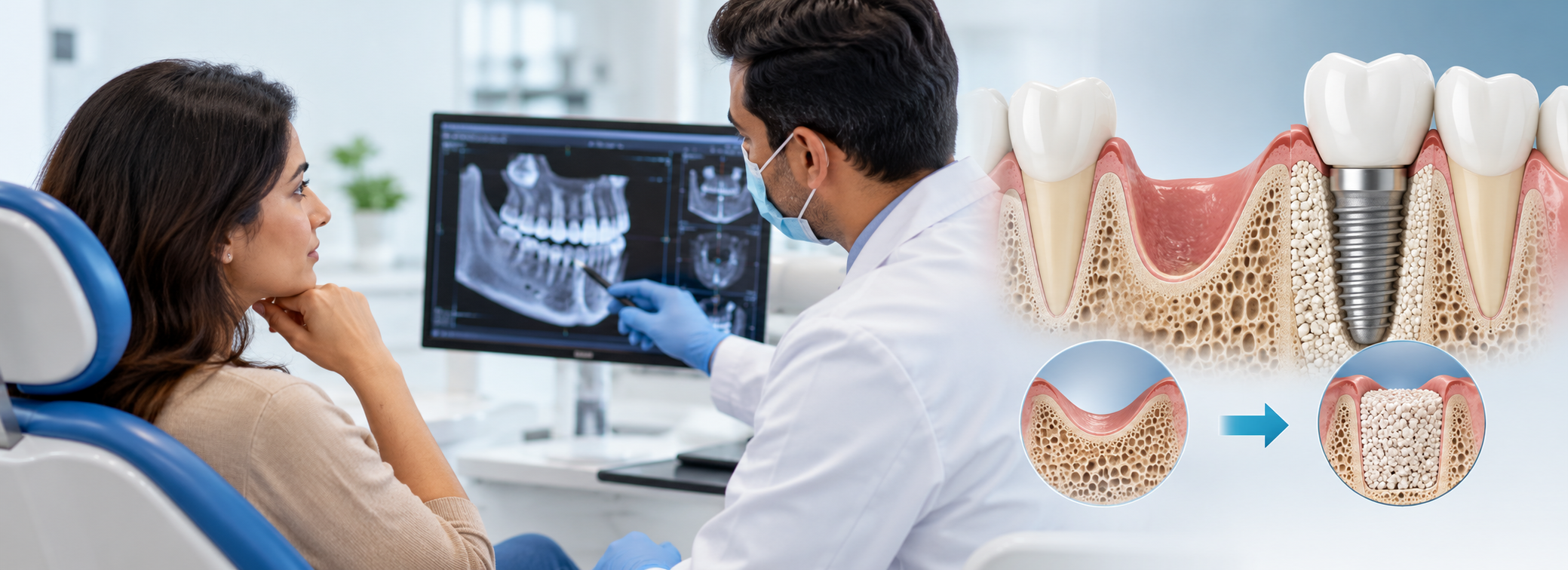
Missing teeth can affect more than the appearance of your smile. Over time, tooth loss may also lead to changes in the jawbone, making replacement procedures more complicated.
Many patients worry that reduced jawbone volume means they cannot receive dental implants.
Fortunately, dental implants with bone loss may still be possible, depending on the amount of available bone, its location, gum health and overall medical condition.
Modern implant dentistry offers different treatment approaches, including bone grafting, sinus augmentation and specialized implant placement techniques.
However, not every patient requires additional surgery, and not every treatment option is suitable for all situations.
Understanding how jawbone loss affects implant placement can help patients make informed decisions about replacing missing teeth.
Quick Answer: Can You Get Dental Implants If You Have Bone Loss?
Yes, many patients with jawbone loss can still receive dental implants. Some have enough remaining bone for conventional implant placement, while others may require bone grafting, a sinus lift or a specialized approach.
The most suitable treatment depends on bone quantity and quality, the location of missing teeth, gum health and individual medical factors.
A dentist or implant specialist can examine the jaw and recommend an appropriate treatment plan.
Why Does Jawbone Loss Affect Dental Implant Placement?
A dental implant is an artificial tooth root, commonly made from titanium or another biocompatible material, that is surgically placed into the jawbone.
The implant acts as a foundation for a replacement crown, bridge or implant-supported denture.
After placement, the surrounding bone gradually integrates with the implant surface through a biological process called osseointegration.
For this process to provide stable support, the implant must be positioned in an adequate amount of healthy bone.
When the jawbone becomes too narrow, too short or develops significant defects, placing a conventional implant can become more challenging.
Insufficient bone may affect initial stability, safe implant positioning and long-term support.
According to the American Academy of Periodontology, suitable bone support, healthy gums and overall oral health are important considerations when assessing dental implant candidates.
American Academy of Periodontology
What Causes Jawbone Loss Before Dental Implant Treatment?
Jawbone loss can develop for several reasons. Understanding the cause helps dentists determine whether additional treatment is necessary before replacing missing teeth.
1. Long-Term Missing Teeth
Natural tooth roots help maintain the surrounding jawbone.
After a tooth is lost, the bone in that area gradually undergoes resorption because it no longer receives the same functional stimulation.
Over time, the ridge may become thinner or shorter.
Patients who have lived with missing teeth for several years may therefore need additional assessment before implant placement.
2. Advanced Gum Disease
Periodontitis is an inflammatory condition affecting the tissues supporting the teeth.
As the disease progresses, it can damage the surrounding bone and contribute to tooth mobility or tooth loss.
Patients with a history of advanced gum disease may require periodontal treatment before receiving implants.
Active inflammation should generally be managed before surgical placement.
3. Tooth Extraction
Some bone remodeling is expected after a tooth is removed.
During healing, the extraction site may lose part of its original width and height.
The extent of these changes differs from patient to patient.
In selected situations, ridge preservation procedures may help limit bone loss and support future restorative treatment.
4. Dental Trauma or Injury
Accidents, fractured teeth and jaw injuries may damage the surrounding bone.
Some injuries produce localized defects that complicate implant positioning.
A clinical examination and suitable imaging can help determine whether the damaged area requires reconstruction.
5. Medical and Biological Factors
Certain medical conditions, medications, previous radiation treatment and individual healing factors may affect bone health or implant treatment planning.
For example, poorly controlled diabetes and smoking can increase the risk of healing complications.
These factors do not automatically exclude every patient from treatment, but they require careful individual assessment.
Are Dental Implants with Bone Loss Possible in Severe Cases?
In selected cases, even severe jawbone loss can be managed with advanced treatment planning.
However, the extent and location of missing bone strongly influence which procedures may be appropriate.
Some patients can receive conventional implants after bone augmentation. Others may benefit from shorter implants, strategically angled placement or specialist techniques.
For patients who are not suitable candidates for implant surgery, bridges or dentures remain valid alternatives.
Dental Implant Treatment Options Compared
| Treatment Option | When It May Be Considered | Important Consideration |
|---|---|---|
| Conventional dental implant | Sufficient bone remains | Grafting may not be required |
| Bone grafting | Jaw ridge lacks enough width or height | Additional healing may be necessary |
| Sinus lift | Reduced bone height in the upper back jaw | Requires careful sinus assessment |
| Short or narrow implant | Selected cases with limited bone dimensions | Not suitable for every defect |
| Angled implants | Certain full-arch replacement cases | Requires detailed surgical planning |
| Zygomatic implants | Selected cases of severe upper-jaw bone loss | Complex specialist procedure |
| Fixed bridge or denture | Implant surgery is unsuitable or not preferred | Alternative to implant-supported treatment |
The appropriate option depends on the patient’s anatomy, medical history, remaining teeth, functional requirements and long-term expectations.
What Is Bone Grafting for Dental Implants?
Bone grafting is a procedure used to rebuild or augment areas of the jaw where additional bone support is needed.
It may be recommended when the existing ridge is too narrow or lacks sufficient height for the planned implant.
During the procedure, a clinician places suitable bone graft material in the deficient area.
Graft material may come from the patient’s own bone, a human donor source, an animal-derived source or a synthetic substitute.
Depending on the technique and material, the graft provides a framework that supports bone regeneration and healing.
When Is a Dental Bone Graft Needed?
A dentist may consider bone augmentation when:
- The jaw ridge is too narrow for the proposed implant.
- Bone height is insufficient for safe placement.
- Periodontal disease or trauma has caused significant bone damage.
- An extraction site needs ridge preservation.
- Additional support is necessary for the planned restoration.
The American Academy of Periodontology’s ridge modification guide explains how rebuilding deficient jawbone areas can improve the conditions for implant placement.
American Academy of Periodontology
How Long Does a Bone Graft Take to Heal?
Healing time depends on the graft’s size, location, material and the patient’s individual healing response.
In some cases, implant placement can take place during the same procedure.
Other situations require several months of healing before the implant can be inserted.
Extensive reconstruction may require a longer treatment period.
Your dentist can explain the expected timeline after evaluating the area.
What Is a Sinus Lift for Dental Implants?
A sinus lift, also known as sinus augmentation, is a surgical procedure used when there is insufficient bone height in the upper back jaw.
The roots of upper molars and premolars are located close to the maxillary sinuses.
After these teeth are lost, the remaining bone may become thinner, and the sinus space may expand downward.
This can leave insufficient vertical bone height for conventional implant placement.
During sinus augmentation, the surgeon carefully elevates the sinus membrane and creates space for bone regeneration, usually with graft material.
The procedure may allow implants to be placed in an area that previously lacked adequate support.
Depending on the clinical circumstances, implants may be placed during the sinus lift or after a healing period.
The American Association of Oral and Maxillofacial Surgeons provides patient guidance on sinus augmentation, including evaluation, surgical techniques and healing.
AAOMS Oral and Maxillofacial Surgeons
Can You Get Dental Implants Without Bone Grafting?
Yes, some patients with reduced jawbone volume can receive implants without undergoing bone grafting.
The decision depends on how much healthy bone remains and whether an implant can be safely positioned within it.
In selected cases, dentists may consider:
- Short implants when vertical bone height is limited.
- Narrow implants where available ridge width is suitable.
- Angled implants in certain full-arch rehabilitation procedures.
- Alternative implant positions that use existing bone support.
However, avoiding bone grafting should not be the primary objective.
An implant must be positioned correctly to support the planned replacement teeth while protecting surrounding anatomical structures.
Not all patients with bone loss qualify for graft-free treatment. A detailed assessment is necessary to determine whether this approach offers an appropriate long-term solution.
How Does a Dentist Check Bone Loss Before Implant Treatment?
Before recommending a dental implant, the dentist evaluates several factors to determine the available bone support and identify potential risks.
1. Clinical Examination
The dentist examines the gums, remaining teeth, bite alignment and proposed implant site.
Signs of gum disease, tooth mobility and other oral health problems are assessed before surgical planning.
2. Dental X-Rays
Dental radiographs help evaluate the teeth, jawbone and surrounding anatomical structures.
They can identify visible bone loss and provide information for the initial treatment assessment.
3. CBCT Scan
Cone-beam computed tomography (CBCT) produces three-dimensional images of the jaw.
When clinically indicated, it helps measure available bone width and height and identify nearby structures such as nerves and sinuses.
This information can assist with implant positioning and decisions about bone augmentation.
4. Medical History Review
The dentist reviews relevant medical conditions, medications and lifestyle factors.
Smoking, diabetes control, previous radiation treatment and certain medicines may influence healing and surgical risks.
5. Personalized Treatment Planning
The final treatment plan considers the available bone, proposed implant dimensions, replacement tooth design, bite forces and long-term maintenance needs.
This comprehensive evaluation helps determine which treatment options are appropriate.
What Factors Affect Dental Implant Success With Bone Loss?
Long-term implant outcomes depend on more than the amount of jawbone available.
Several biological, surgical and lifestyle factors must be considered.
Healthy Gums
Healthy gum tissues help support the area surrounding an implant.
Active periodontal disease should generally be managed before implant placement.
After treatment, regular oral hygiene and professional maintenance remain essential.
Bone Quality and Quantity
The available jawbone must provide suitable support for the proposed implant.
Bone density, ridge dimensions and nearby anatomical structures all influence treatment planning.
Smoking and Tobacco Use
Smoking can interfere with healing and is associated with an increased risk of implant complications.
Patients who smoke should discuss these risks with their dental professional before surgery.
Diabetes and Other Medical Conditions
Diabetes does not automatically prevent someone from receiving implants.
However, poorly controlled blood glucose and some other medical conditions may increase the risk of complications or delayed healing.
Implant Position and Bite Forces
The implant must be positioned to support the planned restoration without creating excessive functional stress.
Careful planning helps reduce avoidable mechanical complications.
Oral Hygiene and Follow-Up Care
Dental implants require consistent plaque control and professional monitoring.
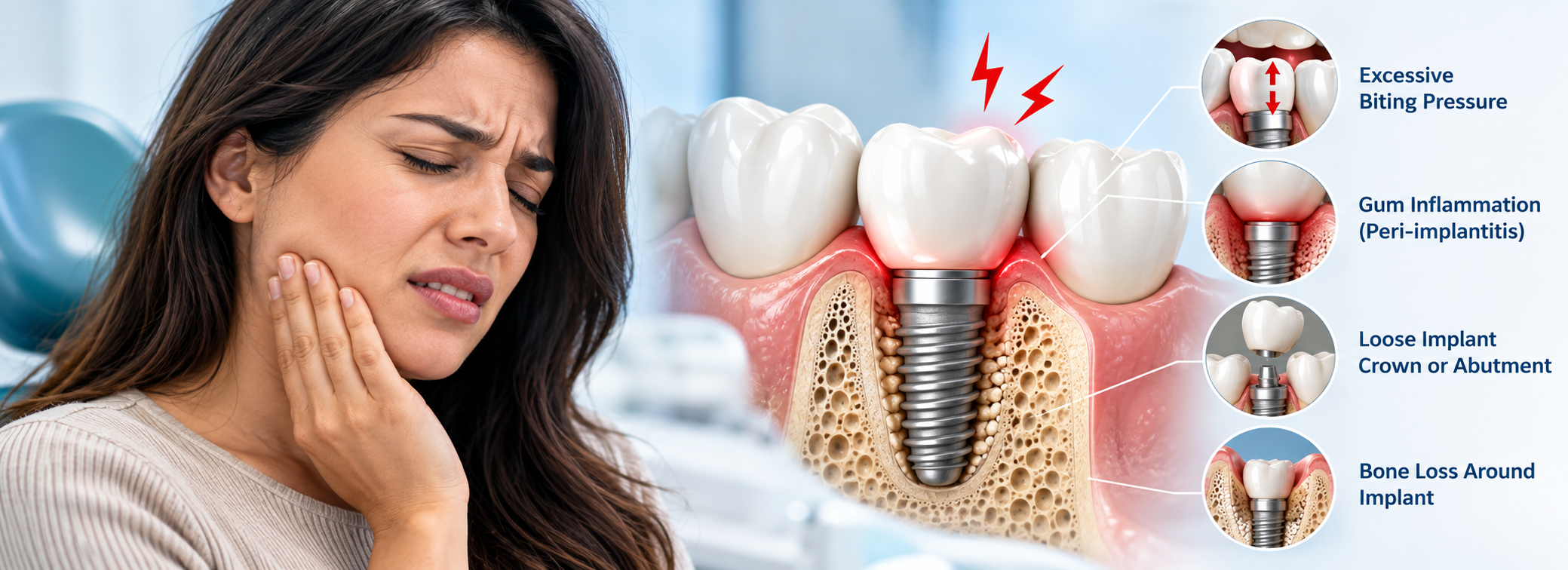
Poor maintenance can contribute to inflammation around an implant and progressive loss of supporting bone, known as peri-implantitis.
The US Food and Drug Administration explains that implants have potential benefits but also carry risks, including infection, injury to nearby structures and implant failure.
FDA
What Happens If There Is Not Enough Bone for Dental Implants?
When the existing jawbone cannot safely support a proposed implant, the dentist may recommend a different treatment approach.
The available options depend on the severity and location of the bone deficiency.
For some patients, bone augmentation can create more suitable conditions for implant placement.
Others may be candidates for alternative implant designs or specialist surgical techniques.
However, when implant treatment is unsuitable or the patient prefers a nonsurgical approach, other tooth replacement methods may be considered.
These include:
Fixed Dental Bridges: A replacement tooth or teeth supported by neighbouring natural teeth or existing suitable supports.
Removable Partial Dentures: Appliances designed to replace one or more missing teeth.
Complete Dentures: Removable replacements for patients missing all teeth in one or both jaws.
Each option has advantages, limitations and maintenance requirements.
The decision should consider oral health, treatment time, financial considerations, expected function and patient preferences.
Dental Implants vs Dentures: Which Is Better for Patients With Bone Loss?
Neither option is automatically better for every patient.
Implants may provide stable support for replacement teeth and help maintain bone around the implant site.
Dentures are a nonsurgical alternative that can restore appearance and function without requiring implant placement.
However, removable dentures do not replace natural tooth roots and do not prevent the normal bone resorption associated with tooth loss.
| Factor | Dental Implants | Removable Dentures |
|---|---|---|
| Surgery | Usually required | Generally not required |
| Bone support | Adequate support is necessary | Can be considered despite significant bone loss |
| Stability | Supported by jawbone | Supported by oral tissues and sometimes remaining teeth |
| Treatment time | May involve several months | Often shorter, depending on the case |
| Maintenance | Daily cleaning and dental reviews | Daily cleaning and periodic adjustments |
| Suitability | Depends on clinical eligibility | Alternative when implants are unsuitable or not preferred |
A dental consultation can help patients understand which restoration is appropriate for their needs.
Frequently Asked Questions About Dental Implants and Bone Loss
1. Can you get dental implants if you have bone loss?
Yes. Many patients with reduced jawbone volume can receive implants. Some may require bone grafting, sinus augmentation or specialized implant placement techniques depending on their anatomy and oral health.
2. How much bone is needed for dental implants?
There is no single minimum bone measurement suitable for everyone. Requirements depend on implant size, location, bone quality, surrounding anatomical structures and the planned restoration.
3. Can severe jawbone loss be treated with implants?
Sometimes. Advanced bone grafting or specialized implant techniques may be considered in selected patients. A specialist evaluation is necessary to establish whether these options are appropriate.
4. Is bone grafting always necessary before dental implants?
No. Some patients have enough suitable remaining bone for conventional, shorter or narrower implants without additional grafting.
5. Can patients with gum disease receive dental implants?
Potentially, yes. However, active periodontal disease generally needs to be treated and stabilized before implant placement. Ongoing periodontal maintenance is also important.
6. Can you receive dental implants after years of missing teeth?
Yes, many people can. However, prolonged tooth loss may result in significant jawbone resorption, requiring additional evaluation or treatment before implants are placed.
7. Is a sinus lift necessary for upper dental implants?
Not always. Sinus augmentation may be recommended when there is insufficient bone height beneath the maxillary sinus in the upper back jaw.
8. How long does dental implant treatment take with bone grafting?
Treatment may take several months or longer, depending on the grafting procedure, healing response, implant integration and final restoration.
9. Can dental implants fail because of bone loss?
Yes. Inadequate support, poor healing, infection or progressive bone loss around an implant can contribute to complications or implant failure.
10. Are dental implants better than dentures for patients with bone loss?
Not necessarily. Implants may provide greater stability for certain restorations, but dentures remain an appropriate option for patients who are unsuitable for surgery or prefer removable tooth replacement.
Conclusion: Bone Loss Does Not Always Rule Out Dental Implants
Jawbone loss can make implant treatment more complex, but it does not automatically eliminate the possibility of replacing missing teeth with implants.
Depending on the extent and location of the bone deficiency, treatment may involve conventional implants, bone grafting, sinus augmentation or specialized implant techniques.
However, successful treatment depends on careful evaluation of bone support, gum health, medical history and restorative requirements.
The most suitable approach is determined by individual clinical findings rather than bone loss alone.
A professional dental assessment is the first step toward understanding whether implant treatment is possible and which options may provide predictable long-term function.
Considering Dental Implants but Concerned About Bone Loss?
Missing teeth and reduced jawbone volume do not always mean implant treatment is impossible.
At Novacare Dental, Pune, patients considering tooth replacement can book a consultation to discuss their concerns and available treatment options.
A clinical examination and appropriate imaging can help determine whether conventional implant placement, bone augmentation or another replacement approach may be suitable.
Book a Dental Consultation at Novacare Dental to discuss your oral health and the next steps toward restoring your smile.